News & Event Archive
GSM Education Blog: Spotlight on SEL (Socio Emotional Learning) & Art in Kindergarten
March 16th, 2021
In the Dolphin Classroom, we always incorporate Social and Emotional Learning into our daily curriculum. Social and Emotional learning (SEL) is defined as an integral part of education and human development. SEL is the process in which all young people learn to develop healthy identities, manage emotions, achieve personal/collective goals, feel & show empathy for others, establish supportive relationships, and make responsible and caring decisions (CASEL 2020).
In the Kindergarten age, when conflict arises many children are finding the balance between needing assistance from adults and independent problem solving. In this project, we embarked on a journey to answer the questions: Is this a child-sized problem or a grown-up sized problem? Can I solve this problem on my own or do I need help from a grown up? What would I have to do or say to solve this problem on my own? After frequent community discussions, exploring different scenarios, and role-playing, the Dolphins gained a better understanding on what it means to be a problem solver and the importance of communication with their peers.
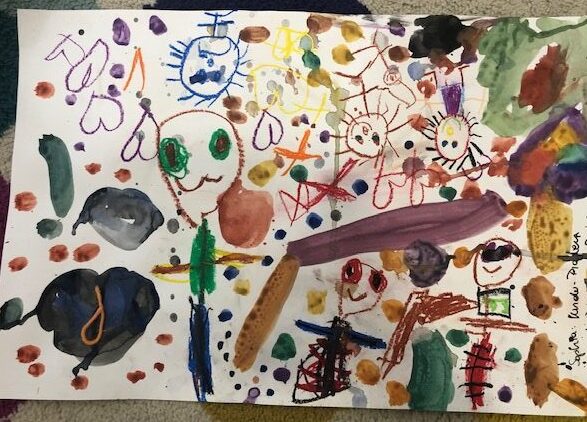
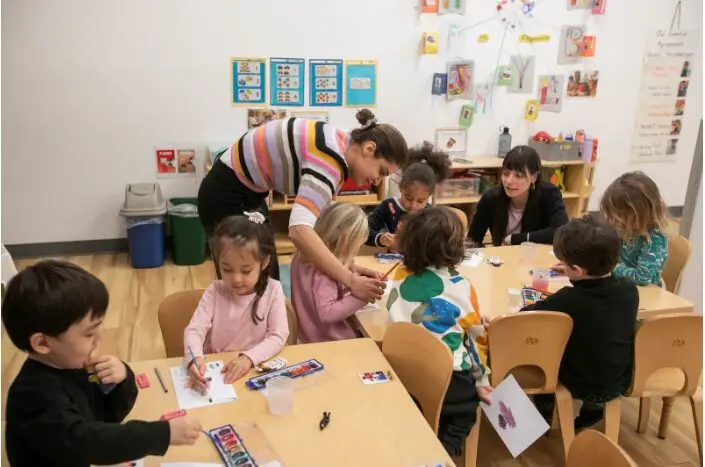
In this project, Dolphins were given the task to work with a partner to create a visual representation of a child sized problem and a grown up sized problem. Here are some of the scenarios they came up with:
Child sized problems: Someone has a toy that you want, you want to join a game that others are playing, there is not enough room for your body on the rug.
Grown-up sized problems: There is a fire, you have a broken leg, someone is repeatedly bothering you and won’t stop.
The IB Curriculum: The Secret to Dual Immersion Success
April 15th, 2023
Introduction
Traditional bilingual programs often focus solely on language acquisition but fail to integrate language learning with other academic subjects. While these programs may enhance proficiency, they do not always encourage critical thinking or active application of language skills. The International Baccalaureate (IB) Bilingual Program takes a more holistic approach, combining language proficiency with interdisciplinary learning. This ensures that students develop both their linguistic and cognitive skills.
In this article, we will dive into why IB programs are a more effective approach to bilingual education.
Why Dual Immersion Alone Isn’t Enough
Many traditional dual immersion programs emphasize fluency in a second language but do not integrate it meaningfully into the broader curriculum. As a result, students may develop passive language skills without the ability to apply them critically in various academic and real-world settings. Without interdisciplinary connections, bilingual learning remains superficial, limiting the development of problem-solving skills, creativity, and cultural understanding. This lack of application across subjects prevents students from fully leveraging their language skills in diverse, real-world contexts.
The Power of the Transdisciplinary Method in Language Learning
IB’s transdisciplinary approach goes beyond memorization and isolated language exercises. Instead, language is embedded across all subjects, ensuring students engage with complex themes and apply their language skills in meaningful contexts. This method:
- Encourages students to explore real-world issues using multiple languages as tools for inquiry.
- Promotes cross-subject collaboration, integrating language learning into science, mathematics, social studies, and the arts.
- Strengthens communication skills by requiring students to articulate ideas across different disciplines, reinforcing both subject matter understanding and language proficiency.
Engaging the Whole Brain: Cognitive Benefits of IB’s Language Approach
Bilingual education in an IB setting is not just about mastering a second language – it enhances cognitive development in several key ways, fostering skills that are essential in both academic and real-world scenarios.
- Strengthened Brain Function – Inquiry-driven learning in multiple languages challenges students to think more flexibly and problem-solve effectively. This adaptability helps students process information more efficiently and apply their knowledge across various contexts.
- Deeper Analytical Skills – Concept-based learning improves reasoning and comprehension, allowing students to make connections between subjects and ideas for a better understanding of the surrounding environment. This broader understanding encourages critical thinking and enables students to draw insightful conclusions about the world around them.
- Improves Cognitive Flexibility and Memory – The ability to switch between languages and tasks strengthens mental flexibility, supporting neuroplasticity—the brain’s ability to reorganize and adapt to new information. This allows bilingual students to more easily adjust to new challenges, improve their multitasking abilities, and strengthen their problem-solving and decision-making skills.
Conclusion
The IB approach to bilingual education goes beyond language proficiency to create a well-rounded, globally-minded individual. By integrating language learning with critical thinking, interdisciplinary study, and real-world application, IB students become adaptable, culturally aware, and prepared to succeed in multilingual environments. Through this comprehensive method, graduates emerge as confident communicators and problem solvers, ready to navigate an increasingly interconnected world.
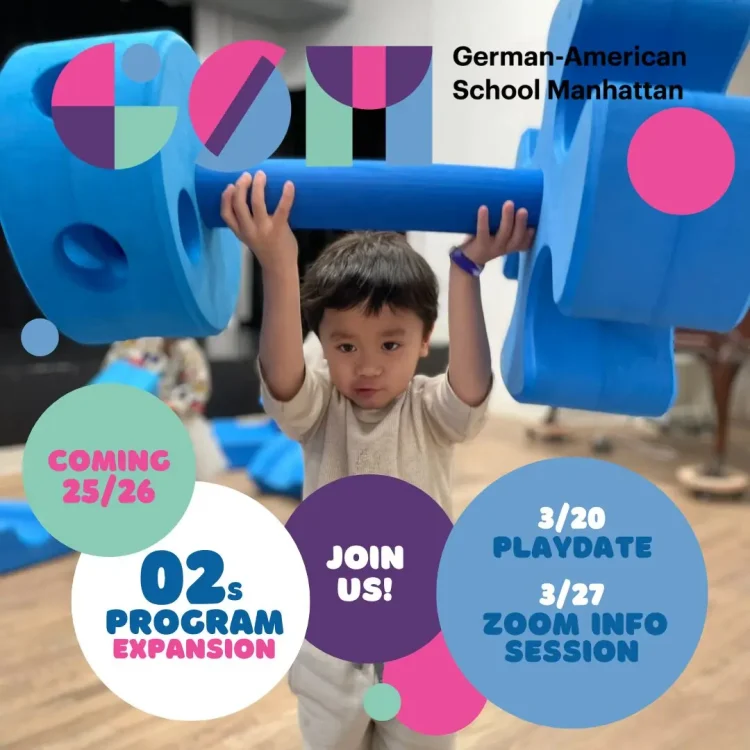
Preschool expanding: the new 02s program
March 4th, 2025
-
Playdate for applicants ages 1-2 on Thursday, March 20th 4PM – 4:45PM
- Zoom Info Session on Wednesday March 27th 12-12:45PM
How to Support Bilingual Children in Their Language Journey
December 2nd, 2024
Parents play a vital role in nurturing their children’s language skills; however, the journey of raising a bilingual child can be especially challenging. To help parents navigate this complex process, this article will explore effective strategies, engaging activities, and practical tips to support bilingual development and promote long-term success for their children.
Creating a Bilingual Environment at Home
The foundation for a bilingual child’s growth begins at home. By fostering a consistent and immersive bilingual environment, parents can offer their children the exposure needed to learn and maintain two or more languages.
One effective approach is to speak both languages consistently. Families with bilingual children should choose a language strategy that better suits their needs, such as the one-parent-one-language method or prioritizing the minority language at home. Committing to using each language regularly is key, even when it feels challenging.
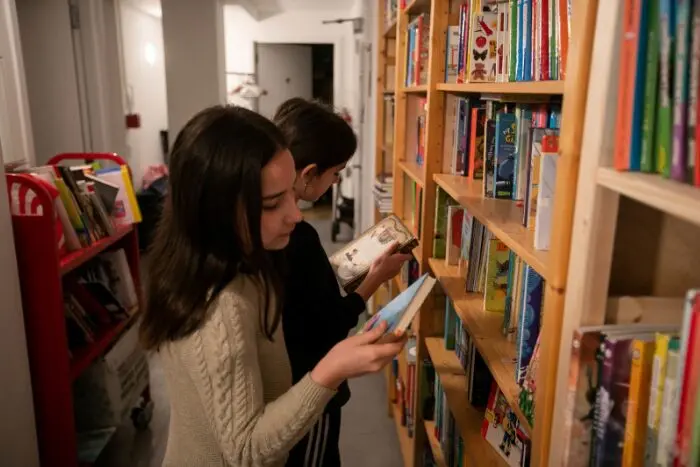
Surrounding bilingual children with multilingual resources also plays a crucial role in supporting their language acquisition journey. Integrating books, music, movies, and other media in both languages into daily routines provides consistent exposure across various contexts. Family members and caregivers can enhance this experience by using both languages during interactions.
Encouraging bilingual playdates is another great way to help bilingual children practice their language skills in social settings. Connecting with other bilingual families allows kids to use both languages naturally, reinforcing their learning while fostering a sense of community. Additionally, celebrating bilingual milestones, such as a child’s first words in each language or their ability to switch languages effortlessly, can boost their confidence and motivate them to continue on their bilingual journey.
Language Learning Activities for Bilingual Children
Engaging bilingual children in fun and interactive language learning activities is essential for their personal and academic growth. For example, storybook reading can significantly enhance language skills. Reading aloud in both languages with different voices and expressions captures children’s attention and sparks their imagination. Encouraging them to ask questions and make predictions about the story fosters critical thinking and comprehension, allowing them to practice their skills in an engaging manner.
Bilingual pretend play is another effective activity that should be incorporated into every child’s learning journey. When bilingual children engage in imaginative play using two languages, they explore various roles and scenarios, which can significantly boost their fluency and creativity. For instance, setting up a pretend store or restaurant provides a natural context for using relevant vocabulary.
Lastly, labeling household items creates a constant visual reminder of vocabulary and helps bilingual children make connections between words and their meanings. This simple yet effective technique reinforces vocabulary development through everyday interactions.
Bilingual School Enrollment
As bilingual children near preschool and school age, parents might consider enrolling them in a dual-language program, providing a solid foundation for their language development. Bilingual schools create structured environments that ensure continued language exposure, reinforcing language skills and supporting ongoing bilingual development. This consistent practice is vital for building fluency and confidence in both languages.
Moreover, bilingual programs often incorporate cultural elements into their curricula, helping children appreciate diversity. This exposure prepares them to thrive in a multicultural world. Additionally, attending a bilingual school gives bilingual children the chance to interact with peers who share similar experiences, fostering a sense of community and enhancing their social skills.
Conclusion
Nurturing a child’s bilingual development is a rewarding journey that shapes their identity and opens up numerous opportunities. By creating a supportive home environment, engaging in interactive language activities, and exploring educational pathways, parents can lay a strong foundation for their children’s growth. Every bilingual child’s language learning journey is unique, so it’s essential to embrace the process and celebrate the milestones along the way.
Three Reasons Why Attending Private School Is Good for Your Kids
December 3rd, 2024
Private schools stand out as distinctive educational centers that encourage intellectual growth and development. These schools are a great alternative to the conventional public school system, catering to families who seek a more personalized and tailored approach to their child’s education. In this article, we will explore key reasons why attending an independent school can be an excellent choice for students and their families.
Academic Excellence in Private Schools
One of the primary reasons parents choose private schools is the promise of academic excellence. Independent schools are often known for upholding rigorous academic standards by offering a curriculum that aims to engage and challenge students. Private Schools typically employ highly qualified and experienced educators committed to helping students achieve their best.
Private schools also have the freedom to customize their curriculum to match the specific interests and strengths of their students. This may include educational programs such as STEM (Science, Technology, Engineering, and Mathematics) or unique electives that reflect the diverse interests of the student body. By providing a dynamic and demanding academic atmosphere, independent schools work to prepare their students for further education and their careers.
Focus on Character Development and Values
Beyond academic achievement, many private schools prioritize character development and the teaching of positive values. They understand that education involves not just transferring knowledge but also shaping individuals who are ready to handle the challenges of today’s world.
Private schools often prioritize inquiry-based learning as a central component of their educational approach. This method encourages students to actively engage with the material by posing questions, exploring topics in-depth, and conducting research to find answers rather than simply receiving information passively. These activities help students build critical skills like analytical thinking, problem-solving, empathy, and ethical decision-making. By nurturing these qualities, private schools strive to graduate students who are not only academically capable but also socially responsible, and prepared to make impactful contributions to their communities.
Small Group Learning and Individualized Support
Another key benefit of private schools is their typically smaller class sizes. Thanks to the reduced number of students in each class, teachers can pay closer attention to every learner, helping ensure no one is overlooked. This personalized approach enables teachers to quickly recognize and address any learning challenges or concerns while encouraging each student’s unique strengths and abilities.
Smaller class sizes also create a more close-knit and supportive learning atmosphere, where students are not concerned about asking questions, joining discussions, and reaching out to their teachers. This degree of individual attention can be especially helpful for students who may find it difficult to thrive in larger, less personal classroom settings.
Considerations When Choosing a Private School
When selecting a private school, it is crucial to carefully consider several factors to make sure that the educational center aligns with your family’s values, needs, and expectations. Some key considerations include:
- Academic Curriculum and Programs: Assess the school’s academic programs by considering the range and depth of its curriculum, the presence of advanced or specialized courses, and the qualifications and experience of its teachers.
- Extracurricular Activities: Evaluate the range of extracurricular opportunities available, such as sports, arts, clubs, and community service initiatives, to ensure that your child’s interests and passions can be nurtured.
- School Culture and Values: Understand the school’s mission, values, and overall culture to ensure that they align with your family’s beliefs and priorities.
- School Facilities and Resources: Consider the quality and condition of the school’s physical infrastructure, including classrooms, libraries, recreational spaces, as well as the availability of modern technology and resources.
- Financial Considerations: Carefully review the tuition fees and any additional costs associated with attending the private school, and ensure that the investment aligns with your family’s financial capabilities and long-term goals.
- Admissions Process: Familiarize yourself with the school’s admissions requirements and procedures to ensure your child is well-prepared for the application process.
In summary, enrolling in a private school provides a distinctive and enriching educational experience that offers many benefits for students and their families. By providing a well-rounded educational program that prepares students for success in academic and personal endeavors, private schools can be a transformative option for families looking to give their children a strong foundation for the future.
To learn more about the unique advantages of private school education, we encourage you to contact our team or sign up for one of our upcoming admissions events. Check out our calendar for available dates.
Discover the Benefits of Bilingual Education
December 17th, 2024
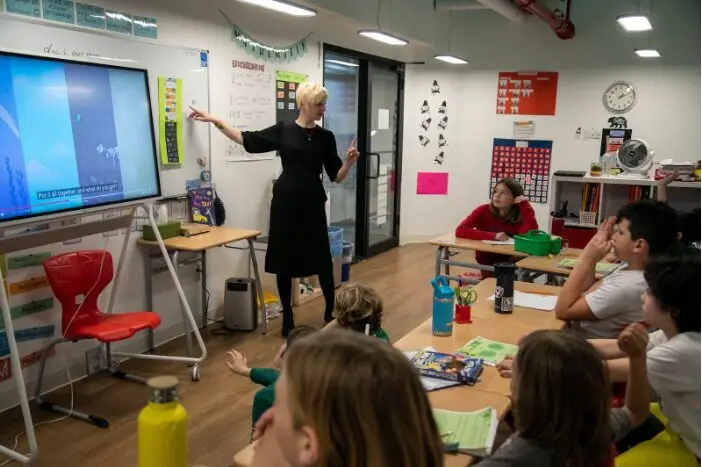
Bilingual education refers to a teaching method that incorporates the use of two languages in the classroom setting. This approach has gained significant recognition in recent years due to its numerous benefits for students. The aim of bilingual education is not only to teach students a second language but also to provide them with a deeper understanding of different cultures.
Cognitive Benefits of Bilingual Education
One of the primary advantages of bilingual education is its positive impact on cognitive development. Research has shown that individuals who are bilingual have enhanced their executive functioning skills. These skills include problem-solving, critical thinking, and multitasking. When students learn multiple languages, they are constantly switching between and managing two linguistic systems. This mental exercise strengthens their cognitive abilities and improves their overall brain function.
Moreover, bilingual education has been linked to better academic performance. Studies indicate that bilingual students tend to have higher levels of concentration and focus, which are essential for academic success. The ability to switch between languages also improves their communication skills, allowing them to express themselves more effectively. Additionally, bilingual students have been found to have improved memory retention, leading to better learning outcomes across various subjects.
Cultural Understanding and Empathy
Another significant advantage of bilingual education is the promotion of cultural understanding and empathy. When students learn a second language, they gain insight into different cultures, traditions, and perspectives. This exposure fosters a sense of empathy and appreciation for diversity. Bilingual education provides students with the opportunity to connect with people from various linguistic backgrounds and helps break down barriers of communication. By understanding different cultures, students become more open-minded, contributing to a more harmonious society.
Furthermore, bilingualism allows individuals to have a deeper understanding of their own culture. By learning a second language, students gain a comparative perspective that allows them to reflect on their own cultural values and norms. This self-awareness fosters a sense of identity and belonging, strengthening their cultural roots.
Long-term Career Advantages
In today’s interconnected world, being bilingual offers significant advantages in the job market. Companies and organizations are increasingly seeking individuals who can communicate effectively across different languages and cultures. Bilingual employees are often perceived as valuable assets, as they can bridge communication gaps and facilitate international business transactions. By embracing bilingual education, students are equipping themselves with a valuable skill set that can open doors to a wide range of career opportunities.
Moreover, bilingual individuals often have a competitive edge when it comes to cognitive flexibility and problem-solving skills. These qualities are highly sought after in fast-paced and globalized work environments. Bilingualism allows individuals to adapt more easily to new situations, think creatively, and approach challenges from different angles. As a result, bilingual professionals are often seen as adaptable and resourceful, making them desirable candidates for leadership roles.
In conclusion, bilingual education offers a multitude of advantages, ranging from cognitive development to cultural understanding and improved academic performance. By nurturing cognitive abilities, enhancing language acquisition, and promoting cultural empathy, it equips students with the skills necessary to succeed in an increasingly globalized world.
GSM is an IB World School
April 11th, 2025
Dear GSM Families, Friends & Supporters,
We are absolutely thrilled to share an exciting update with you. We have received final confirmation from the IBO that we were granted approval for authorization: GSM is officially an IB World School authorized to teach the Primary Years Programme (PYP).
The IBO has expressed to us that they were very impressed with our program, especially on how the teachers are collaborating and how the school is managing to promote student agency. During our IB candidacy, we have systematically worked all the steps and stages to build a world-class curriculum.
Please scroll down for community updates and upcoming admissions events, we’d love to connect with you.
Wishing you a lovely Spring Break,
Julia Stratmann & the GSM Team
Read the entire NEWSLETTER
The Benefits of Private School Education
January 25th, 2023
The foundation for a child’s future success begins with their education. For parents, choosing the right school is a critical decision in shaping that future. This article takes a closer look at the benefits of private school education and how it can significantly contribute to a student’s learning and overall development.
Private Schools Offer Specialized Curriculums
One of the standout features of private schools is their specialized curricula, designed to provide a well-rounded and challenging education. Unlike traditional public school programs, private schools often tailor their curriculum to meet the needs of their students, incorporating innovative teaching methods and interdisciplinary approaches.
For example, GSM’s curriculum combines German and American bilingual education, allowing students to develop fluency in both languages. This type of immersive learning prepares students for a globalized world while strengthening cognitive skills. Additionally, specialized curricula provide students with opportunities to explore subjects in greater depth, ensuring they are academically challenged and engaged.
Extracurricular Opportunities in Private Schools
Beyond academics, private schools place a strong emphasis on extracurricular activities, offering a diverse range of options that may not be available in other educational settings. These activities, which include sports, arts, theater, dance and many more, contribute to a well-rounded education by fostering leadership, teamwork, and personal growth.
Participating in extracurriculars allows students to discover new interests, develop social skills, and build meaningful relationships. Whether it’s joining a chess club, playing on a soccer team, or participating in theater performances, these opportunities help students build confidence and develop essential life skills that extend beyond the classroom.
Personalized Learning in Private Schools
Students also benefit from a personalized learning experience when engaging in a private school education. Personalized learning is essential for a student’s growth as it takes into account the personal academic struggles a student faces and meets them where they are at. Under this method, students can feel more confident in their learning journey.
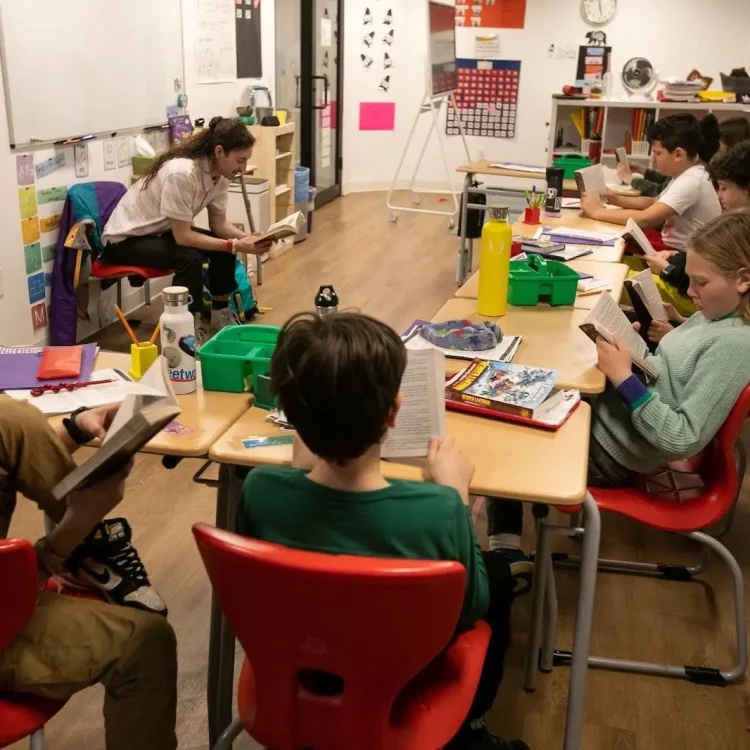
Private schools among many other qualities are known for offering small class sizes as a part of the education environment. With small class sizes, your child can bond with peers more meaningfully, and the smaller community offers more individualized attention to a student’s educational needs. Additionally, small class sizes allow for one-to-one assistance from teachers, which can aid students in tackling harder topics and making sure they understand the topic thoroughly and concisely. Under this learning environment, teachers can understand a student’s education styles and cater to those needs to ensure that each student receives the best learning experience.
Overall, private schools come with many benefits which can be a pivotal stepping stone for a child’s future academic success. Through specialized curricula, quality extracurricular activities, and personalized learning, students are given the tools they need to thrive academically and socially. If you think a private school education is a good fit for your child, consider checking out GSM for more information regarding school life, curriculum, and extracurricular activities.
New Open House and Community Playdates
January 7th, 2026
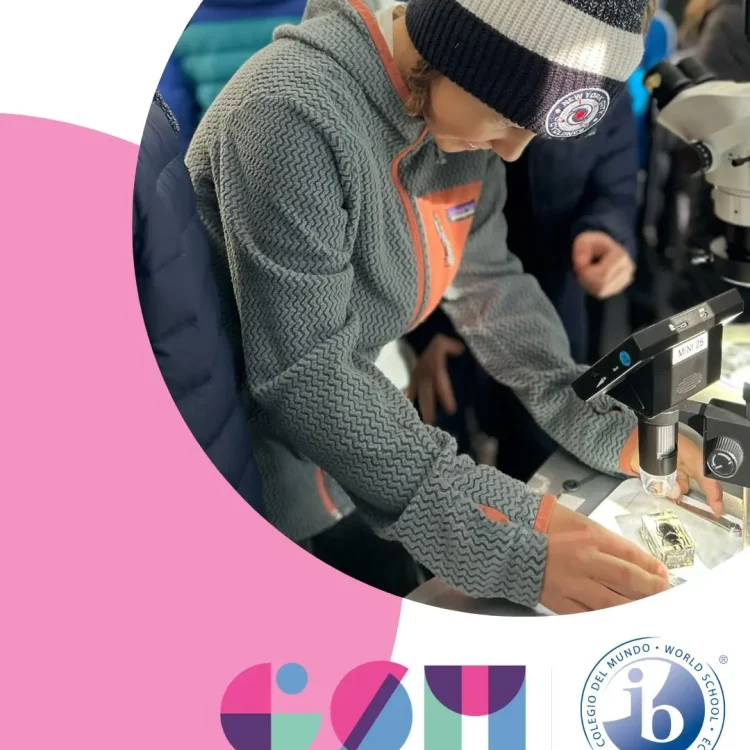
Open Houses & Playdates
In-person open house tours at 74 & 85 Warren Streets
Hurray! Winter Tour Season is on. Here are our upcoming tour dates:
- 1/8, 1/20, 1/30, 2/5, 2/12
Sign up for open houses here
Virtual Zoom tours
Please inquire about Zoom appointments
The open format community playdate is returning this upcoming school year! The playdate is for Kids ages 1-6 accompanied by at least one parent.
The play date is a wonderful opportunity for interested families to meet other GSM families and have their kids experience our school first hand. Parents can chat with educators in a casual setting and get unique answers and insights.
Next community playdate tours are:
- 1/15, 2/3, 3/12
Sign up for playdates here
Enhancing Bilingual Education Through Cultural Immersion and Field Trips
February 15th, 2023
Bilingual education extends beyond the classroom, requiring real-world engagement to develop true language proficiency. At the German-American School Manhattan (GSM), cultural immersion and field trips play a vital role in enhancing students’ language skills and cultural understanding. By integrating interactive activities and hands-on experiences, GSM ensures that students gain fluency and a deeper appreciation for the cultures associated with the language they are learning.
Cultural Immersion Activities at GSM
Cultural immersion is an essential aspect of GSM’s bilingual curriculum, providing students with meaningful opportunities to practice their language skills in interactive and engaging environments. The school organizes a variety of activities throughout the year that immerse students in the language, enabling them to gain both linguistic and cultural insights.
GSM hosts open mic events, where students get a chance to perform in the target language, whether through poetry, storytelling, or music. These events encourage students to refine their speaking and listening abilities in a relaxed and creative atmosphere, fostering self-expression and confidence in their language skills.
Additionally, GSM offers a range of after-school activities conducted in the target language, including dance, music, theater, soccer, and chess. These extracurricular activities allow students to further develop their language proficiency while engaging in the activities they enjoy. For example, students participating in a theater class not only learn the language associated with drama but also explore the expressive cultural aspects of performance. Similarly, sports activities and chess clubs help students apply strategic language in collaborative settings, reinforcing their communication and teamwork skills.
Native-speaking teachers play a central role in these immersive experiences, offering insights into the language and its cultural context. By interacting with the language in diverse settings, students enhance their fluency while gaining a deeper understanding of the language’s cultural roots.
Field Trips as Language Learning Opportunities at GSM
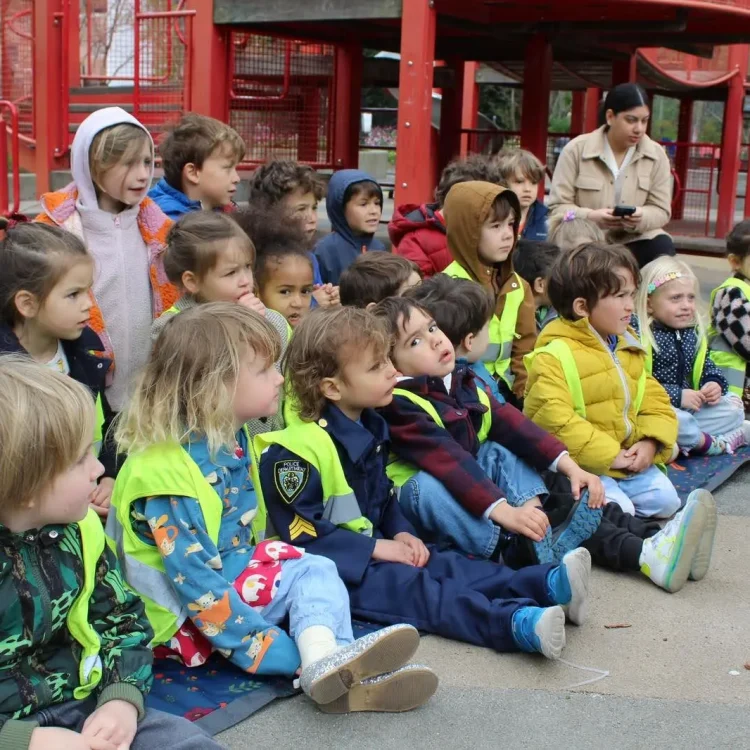
Field trips are another valuable component of GSM’s bilingual education program. These excursions provide students with the opportunity to interact with the language and culture in real-world settings, further reinforcing their classroom learning.
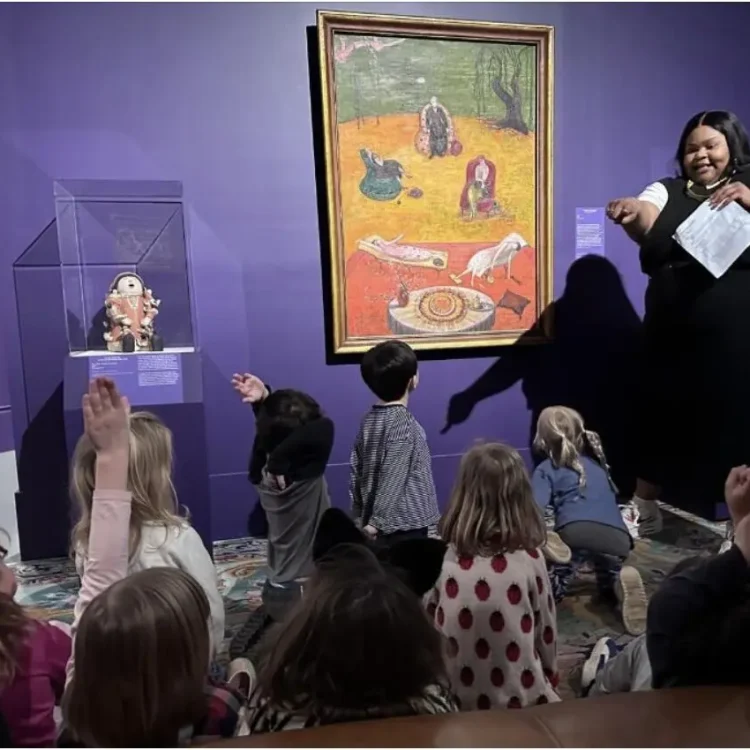
GSM organizes visits to local museums, historical sites, and cultural institutions, where students can practice their language skills while exploring the rich cultural resources of New York City. During these trips, students engage in interactive tasks such as guided tours, group discussions, and scavenger hunts, all conducted in the target language. This hands-on approach helps students apply their language skills in practical situations, reinforcing vocabulary, comprehension, and conversational abilities.
Field trips also allow students to interact with native speakers and local experts, creating real-world opportunities to use the language outside the classroom. These experiences foster deeper language proficiency and cultural understanding, making the learning process both relevant and meaningful.
Conclusion
By offering hands-on experiences and real-world exploration, GSM enables students to develop practical language skills while broadening their cultural understanding. This approach goes beyond simple language acquisition, turning bilingual education into a deeper exploration of the world. Through cultural immersion and field trips, GSM prepares students to become global citizens, fluent in both language and the cultural nuances that influence communication and connection.
The role of technology in modern bilingual education
March 10th, 2023
Technology is reshaping the landscape of bilingual education, offering new opportunities for students to engage with language learning in innovative ways. With these advancements, the process of acquiring new languages has become more interactive, personalized, and effective than ever before. This article explores how these transformative tools are improving bilingual education and helping students connect with languages in meaningful ways.
Key Technologies Transforming Bilingual Education
The landscape of bilingual education has been dramatically altered by the introduction of several key technologies. These innovative tools have opened up new possibilities for language learning and cultural immersion, making the process more engaging and effective than ever before.
- Speech Recognition and Natural Language Processing: These technologies enable students to practice their pronunciation and receive instant feedback. By analyzing speech patterns and intonation, these tools can help learners refine their accent and improve their overall fluency in the target language.
- Cloud-based Collaboration Tools: Cloud platforms enable seamless collaboration between students and teachers within the school community, making bilingual education more interactive and engaging. These tools allow students to practice language skills, access learning materials, and participate in group activities both in and out of the classroom, enhancing their overall learning experience.
- Adaptive Learning Systems: These platforms use data analytics to track student progress and adjust the difficulty level of lessons in real time. This ensures that learners are always challenged at an appropriate level, maintaining their motivation and engagement throughout the learning process.
By incorporating these technologies into bilingual education programs, schools, and institutions can create more dynamic and effective learning environments. These tools not only enhance the acquisition of language skills but also foster cultural understanding and global awareness among students.
Mobile Apps for Bilingual Learning
The proliferation of smartphones and tablets has led to an explosion of mobile applications designed specifically for bilingual education. These apps offer a convenient and accessible way for learners to practice their language skills anytime, anywhere.
Benefits of Mobile Apps in Bilingual Education:
- Portability: Students can access learning materials on-the-go, making it easy to integrate language practice into their daily routines.
- Interactivity: Many apps incorporate gamification elements, making the learning process both engaging and enjoyable.
- Multimedia Integration: Apps can combine text, audio, and video content to create rich learning experiences that cater to different learning styles.
- Instant Feedback: Many language learning apps provide immediate feedback on pronunciation, grammar, and vocabulary usage, allowing students to quickly identify and correct errors.
- Progress Tracking: Built-in analytics tools help learners monitor their progress and set achievable goals.
While mobile apps offer numerous advantages, it’s important to note that they should be used as a supplement to, rather than a replacement for, traditional classroom instruction. When integrated effectively into a comprehensive bilingual education program, these apps can significantly enhance the learning experience and accelerate language learning.
Gamification in Bilingual Education
Gamification has emerged as a powerful tool in bilingual education, transforming the way students engage with language learning. By incorporating game-like elements into educational activities, gamification taps into learners’ natural desire for competition, achievement, and reward.
Key Elements of Gamification in Bilingual Education:
- Points and Rewards: Students earn points or virtual currency for completing language tasks, motivating them to continue learning.
- Leaderboards: Friendly competition among peers can drive engagement and encourage students to push their language skills further.
- Levels and Progression: As learners advance through different levels, they experience a sense of accomplishment and are motivated to tackle more challenging language concepts.
- Quests and Challenges: Gamified platforms often present language learning tasks as quests or challenges, making the process more exciting and goal-oriented.
- Badges and Achievements: Visual representations of accomplishments help students track their progress and celebrate milestones in their language learning journey.
Gamification in bilingual education offers several benefits:
- Increased Motivation: The game-like elements make language learning more enjoyable, encouraging students to spend more time practicing.
- Reduced Anxiety: By framing language learning as a game, students may feel less pressure and anxiety about making mistakes.
- Immediate Feedback: Gamified systems often provide instant feedback, allowing learners to quickly identify areas for improvement.
- Personalized Learning Paths: Many gamified platforms adapt to individual learning styles and paces, ensuring that each student receives an optimized learning experience.
- Enhanced Retention: The repetitive nature of games, combined with the emotional engagement they create, can lead to better retention of language concepts.
Conclusion
Looking to the future, we can expect technology to play an even more significant role in bilingual education. Nevertheless, it remains essential to recognize technology’s role as an enhancement rather than a replacement for human elements in language learning. The significance of qualified educators, cultural immersion, and in-person interaction will continue to be fundamental in developing bilingual proficiency.
Why IB Schools Set the Global Standard for Academic Excellence
March 31st, 2023
German School Manhattan is pleased to announce its authorization of the Primary Years Programme (PYP), marking a significant milestone in its commitment to high-quality education. The PYP is the first stage of the IB or International Baccalaureate (IB) program, which extends into middle school and higher education. It is a well-reputed program that has garnered popularity and influence worldwide in the last few years.
What Is the PYP?
PYP, or Primary Years Programme, is a program that is geared towards students aged 3-12 and offers a unique foundation for educational excellence. This program lays a foundation for students’ learning to be continuously challenged and grow well in their early years of learning. Through the integration of collaborative projects, discussion, and hands-on activities, students are engaged and can actively participate in their learning. The PYP also emphasizes a transdisciplinary approach that integrates subjects through 6 broad themes, ultimately creating meaningful connections and real-world relevance throughout their learning journey.
What makes IB Education stand out?
An IB education offers a unique educational experience for students in that it builds inquiry-based learning. Rather than note-memorization, which is often found in traditional schooling mediums, student-led learning offers students the opportunity to learn deeply and build upon their knowledge.
Alongside other educational programs, the International Baccalaureate (IB) curriculum is widely recognized by universities across the globe and is often preferred by students who move frequently due to its standardized and internationally accepted framework. The IB program provides a strong academic foundation from an early age, fostering critical thinking, global awareness, and interdisciplinary learning. This rigorous approach prepares students not only for higher education but also for real-world challenges, equipping them with the skills needed to thrive in an increasingly interconnected world.
Multilingual Emphasis is another benefit of the program as it encourages bilingualism and prepares students for a globalized world. Students who can speak a second language can better adapt to a culturally diverse environment, which can be advantageous in future workspaces as it fosters better communication. The IB program places a great deal of emphasis on bilingual fluency, integrating it into its curriculum to foster a student’s overall character-building prowess.
A Curriculum Built for the Future: Why IB Students Are Better Prepared for an Unpredictable World
Students in the IB program are better equipped to meet the challenges through the use of critical thinking skills, adaptability, collaboration, and problem-solving. With the rigorous curriculum of IB, students learn to hone these necessary skills for the 21st century. Additionally, the IB program places focus on balancing both STEM and humanities, ensuring that students are well-rounded with the development of both their technical and creative thinking skills. Lastly, the IB curriculum promotes global citizenship by equipping students with ethical decision-making skills in a rapidly changing world.
Conclusion
Overall, the IB program offers a variety of curriculum benefits that focus on growing a student to think critically and foster educational growth and character development. With its emphasis on global citizenship, inquiry-based learning, and multilingualism, the IB program is preparing the next generation of leaders to thrive in an ever-changing world.
Happy Winter Break & Happy New Year!
December 19th, 2025
Dear GSM Community,
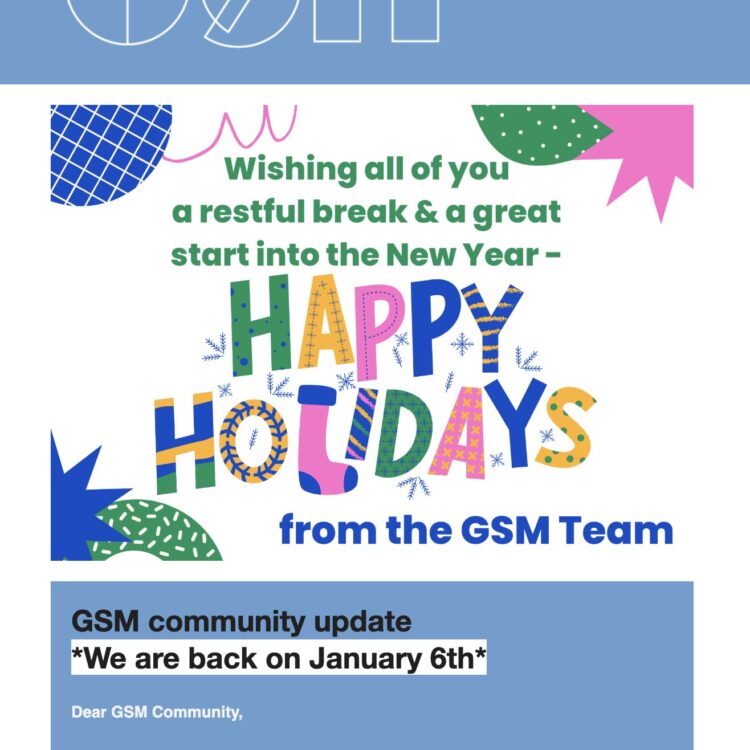
At this time of the year, we are especially grateful for our wonderful GSM community. Many of you will be traveling to visit family and friends near and far, and we hope that – wherever your celebrations may take you – you find moments of rest, reflection, and renewal.
We wish you all safe travels and a joyful, restful holiday season.
Warm regards,
the GSM team
Read the full newsletter here!
Inquiry-Based and Concept-Based Learning in the IB Primary Years Programme
May 10th, 2023
In today’s rapidly evolving world, traditional rote memorization methods are no longer sufficient to prepare students for the challenges ahead. Instead, educational systems must cultivate learners who are curious, thoughtful, and capable of navigating a complex landscape. This is where the International Baccalaureate (IB) Primary Years Programme (PYP) stands out, placing a strong emphasis on inquiry-based and concept-based learning to foster a deeper understanding of content and lifelong learning skills.
What is Inquiry-Based Learning?
Inquiry-based learning is a dynamic and student-centered approach that encourages learners to explore questions, investigate problems, and construct knowledge through active involvement. Instead of passively receiving information, students take ownership of their learning journey.
There are various types of inquiry-based learning:
Structured Inquiry: Teachers provide a clear question and guide students through the process.
Guided Inquiry: Students explore a problem using teacher-provided resources but reach their own conclusions.
Open Inquiry: Students formulate their own questions, conduct investigations, and share findings independently.
For example, in an IB PYP classroom studying ecosystems, instead of simply reading about habitats, students might ask, “How do animals adapt to survive in extreme environments?” They would then research, conduct experiments, and present their findings – building knowledge and essential skills.
Benefits of Inquiry-Based Learning
Inquiry-based learning comes with a range of benefits that align with the goals of the IB programme. The first is that it encourages critical thinking, where students learn to ask meaningful questions, evaluate evidence, and draw reasoned conclusions. Additionally, it promotes a deep understanding and learning retention. By actively engaging with the material, students make stronger connections that support long-term understanding. The IB program also fosters independence and lifelong learning. Learners develop confidence in their ability to explore and problem-solve independently. Improves Communication Skills: Inquiry often involves collaboration, presentations, and discussions, sharpening communication and social skills.
Real-World Application: Students connect what they learn to real-life situations, making education relevant and practical.
Importance of Concept-Based Learning
While inquiry drives the process, concept-based learning gives it direction and depth. It focuses on key ideas that transcend individual subjects and topics, encouraging students to see patterns and make connections.
Concept-based learning is essential because it:
- Encourages transferable understanding that students can apply across disciplines.
- Moves learners beyond facts to “why” and “how” questions.
- Builds a framework for future learning that is meaningful and cohesive.
For instance, a concept like “change” might be explored through history, science, and literature, helping students to understand that change is a universal principle.
Conclusion
The IB Primary Years Programme’s commitment to inquiry-based and concept-based learning is more than an educational trend—it’s a future-focused philosophy. By encouraging students to explore, question, and think critically, these approaches equip young learners with the tools they need to thrive in a constantly changing world. This holistic method not only enhances academic achievement but also prepares students to be adaptable, lifelong learners capable of addressing complex, real-world challenges with confidence.
McNally Jackson x GSM PA BOOK FAIR
November 25th, 2025
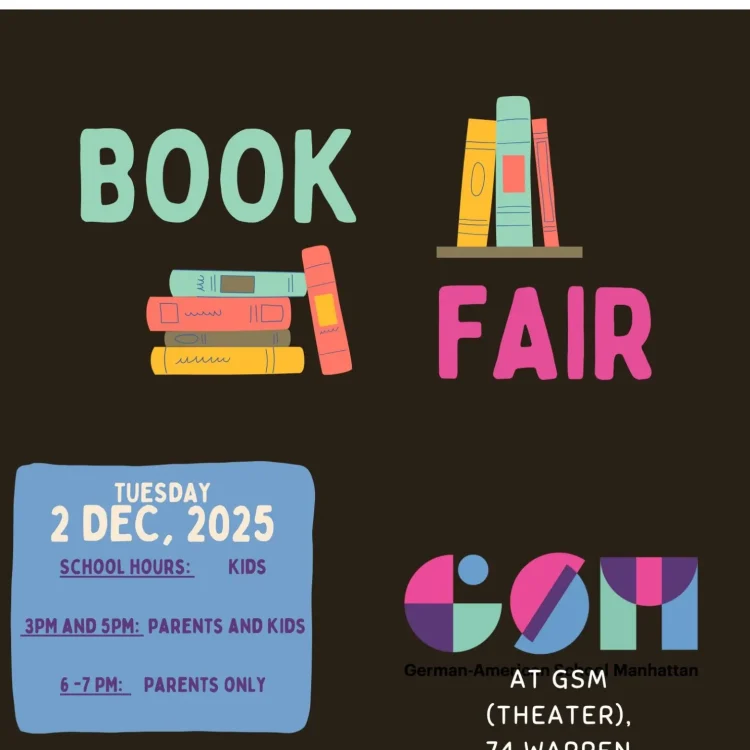
We’re thrilled to host our second in-house GSM PA Book Fair with the independent bookseller McNally Jackson!
When: Tuesday, December 2
Where: GSM Lower School Theater
During the school day, students will browse and purchase fantastic new books with their teachers.
Families are warmly invited to:
- join us at dismissal with your child (3:00-5:00 PM)
- or drop in later in the early evening to shop for yourself (6:00-7:00 PM)
Stock up on books for the holidays or gift something special to friends and family.
Also: GSM receives 20% of all net sales to help us grow our English library. HURRAY!
City Harvest | GSM Food Drive
November 18th, 2025
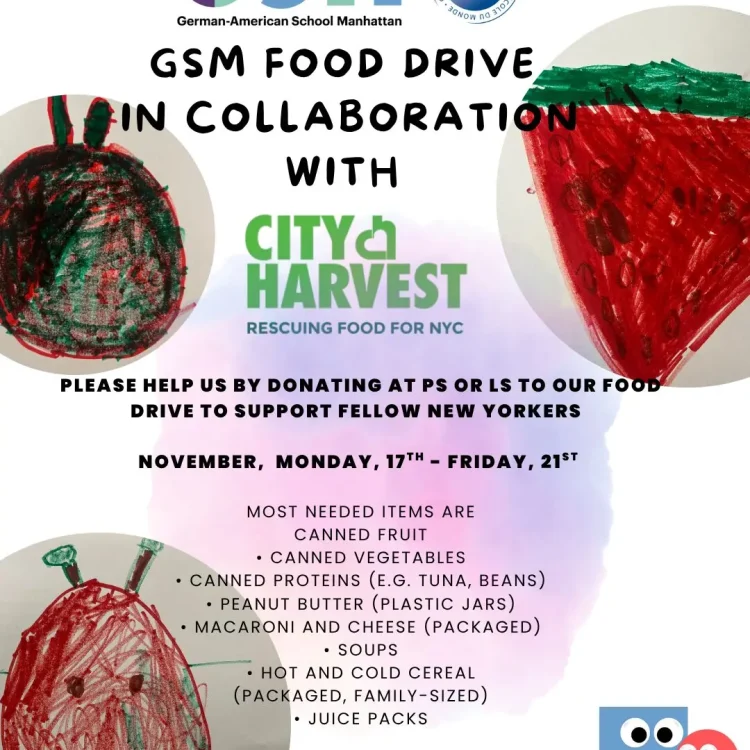
We are caring at GSM! It’s that time of the year again when we come together as a community to help others! Our GSM City Harvest Food Drive will take place from November 17-21. Please consider donating food items (see the flyer) – every contribution helps families in need across New York City.
Collection boxes will be placed in the LS and PS classrooms and GSM lobby area. Let’s fill them up and show the power of our caring GSM community! Thank you so much for your help!
GSM Parent Association hosts Lantern Walk 🏮
October 28th, 2025
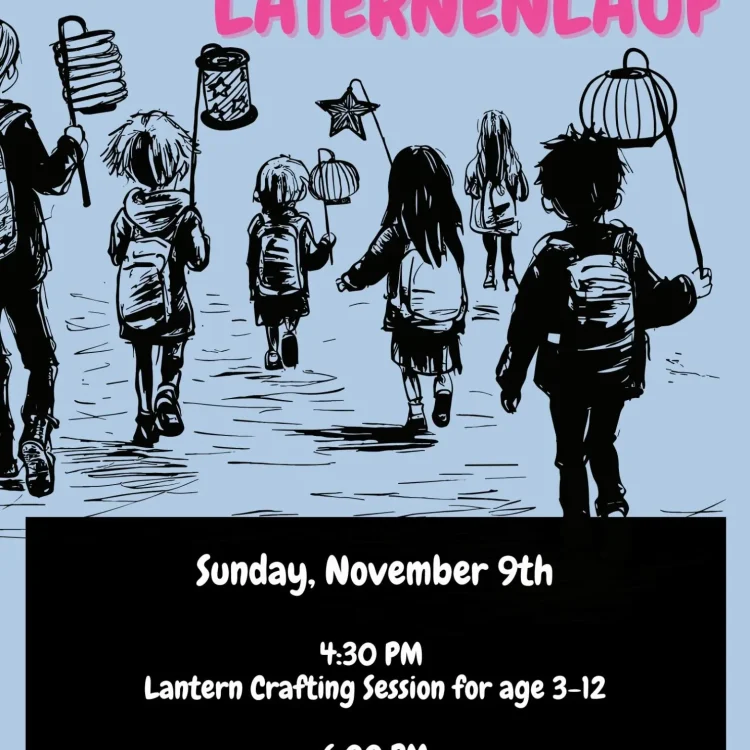
The GSM Parents Association warmly invites you to join us for this year’s St. Martin’s Laternenlauf (Lantern Walk)!
For those unfamiliar with this beloved tradition, it originates from the story of Martin of Tours, a Roman soldier who shared his cloak with a cold beggar on a winter’s night. The story celebrates kindness and generosity, offering a beautiful opportunity to reflect on these values with our children.
The Lantern Walk is also a cherished time for our community to come together – to sing, walk, and enjoy a cozy evening in good company.
Please note: Registration is required for this event. 
For questions, please contact gsm-pa@googlegroups.com.
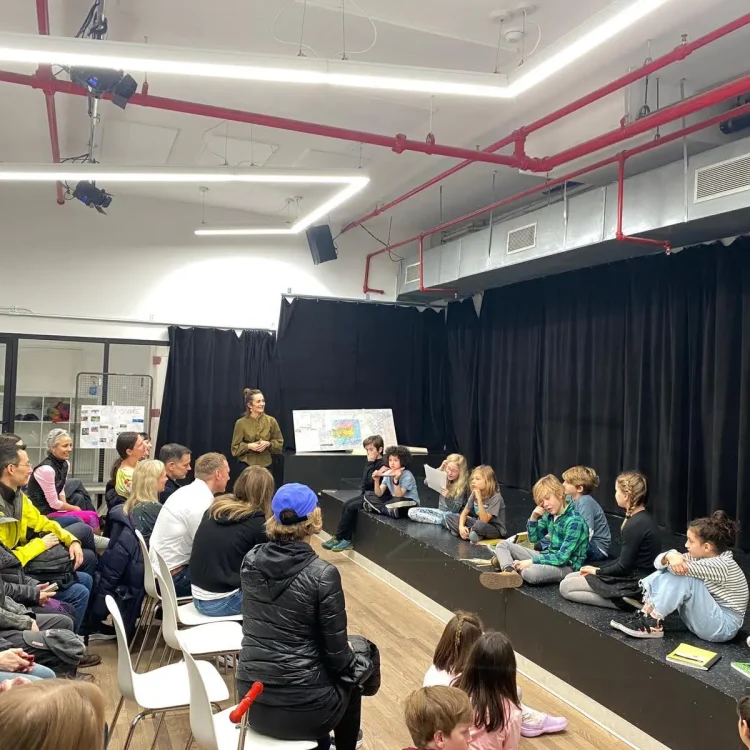
How IB Connects GSM to a Global Network of Top Schools
June 15th, 2023
Introduction
The International Baccalaureate (IB) is a globally recognized educational framework that connects schools, educators, and students across the world. Through a shared commitment to high standards, holistic development, and international-mindedness, IB schools form a strong global network that benefits all involved. This interconnected system provides students and educators with access to a wealth of resources, opportunities, and a common educational philosophy. For schools like GSM, being part of the IB community enhances the educational experience, offering students a unique and comprehensive pathway to academic success and global awareness.
Global Connection in Action
One of the primary benefits of being part of the IB network is the access it provides to a wide array of global resources and initiatives. Students at IB schools can participate in international projects, cultural exchanges, and collaborative ventures with peers from all over the world. These experiences not only broaden students’ horizons but also encourage them to think critically about global issues and develop a sense of responsibility towards others.
For educators, the IB network offers ongoing professional development, collaboration opportunities, and a platform to share best practices with colleagues worldwide. Teachers can draw on the collective expertise of the global IB community, gaining insights into innovative teaching methods and curriculum design. This shared commitment to high-quality education creates a dynamic learning environment for both students and educators, fostering a culture of continuous growth and improvement.
International-Mindedness and Cultural Competence
A core principle of the IB framework is the promotion of international-mindedness. IB schools place a strong emphasis on developing students’ ability to appreciate and respect cultural diversity, fostering an understanding of the world beyond their immediate surroundings. This focus on cultural competence helps students build a sense of global citizenship, equipping them to navigate and contribute to a multicultural society.
GSM’s partnership with Pine Street School exemplifies how these values can be applied in practice. Through this collaboration, GSM students gain access to a rich array of resources, including opportunities for cultural exchanges, joint projects, and global networking. This partnership enriches the educational experience by allowing students to engage with different perspectives and develop a deeper understanding of the world around them.
From Kindergarten to University: How IB’s Approach Aligns with Top Universities’ Expectations
One of the defining features of the IB system is its continuum of education, which spans from the Primary Years Programme (PYP) through the Middle Years Programme (MYP) and onto the Diploma Programme (DP) or Career-related Programme (CP). This seamless progression ensures that students are well-prepared at every stage of their academic journey, from kindergarten through to university.
IB’s focus on academic rigor, critical thinking, and holistic development is highly valued by top universities around the world. Many elite institutions recognize the IB Diploma as a marker of a student’s ability to handle complex academic challenges, manage their time effectively, and think independently. The skills and knowledge students acquire through the IB framework make them well-equipped for the demands of higher education, particularly in competitive fields that require strong analytical, research, and problem-solving abilities.
Compared to other pre-university programs, the IB stands out for its comprehensive and challenging approach. The balance of academic coursework, community service, and the emphasis on developing global awareness sets IB students apart, making them highly sought after by universities worldwide.
Conclusion
The International Baccalaureate system connects students and educators to a global network of top schools, offering access to valuable resources and opportunities. Through partnerships like GSM’s with Pine Street School, students gain a diverse learning experience that fosters academic excellence, personal growth, and international-mindedness. The IB framework prepares students with the skills and mindset to succeed in a globalized world.
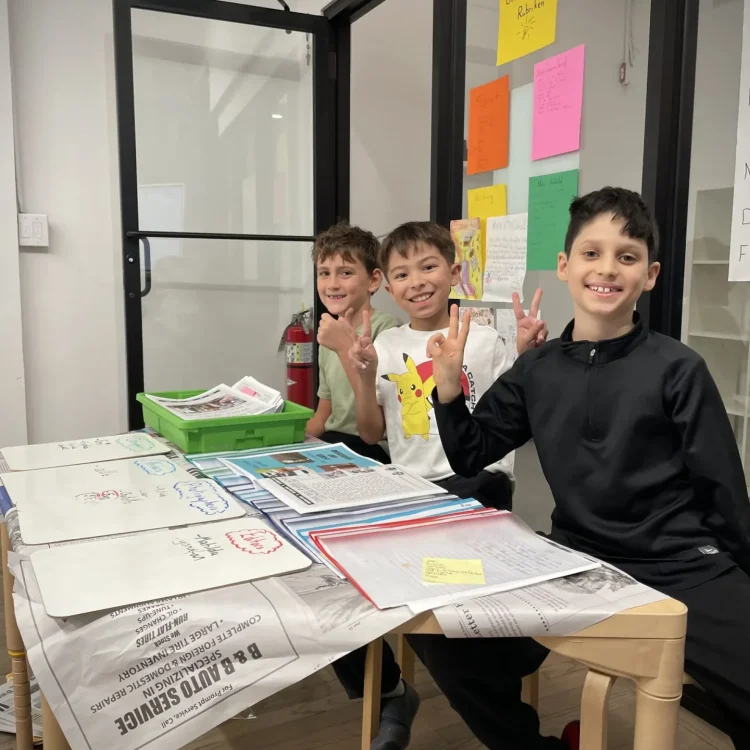
We are bilingual! What is your superpower?
October 8th, 2025
Dear GSM Friends & Families,
We are Bilingual! What’s Your Superpower?
The Power of Bilingual Education
Bilingual education is the academic model of the future. Studies, including brain-scan research, show that bilingual individuals have denser gray matter than their monolingual peers. At GSM, we see this every day: students who start with no prior German knowledge develop impressive command of the language within just a few months.
A bilingual program is academically challenging by nature, yet it fosters a culture of joyful learning, curiosity, and open-mindedness. Our students learn not only two languages, they learn to see the world through multiple perspectives.
Why it matters
Cognitive Elasticity
Bilingual minds are naturally flexible. Research shows they have a greater ability to adapt, multitask, and switch between complex tasks. A life skill that lasts well beyond the classroom.
Advanced Problem-Solving
Bilingualism sharpens critical-thinking skills and strengthens mathematical and analytical reasoning – giving children a lifelong advantage in creative and logical thinking.
Heightened Social Awareness
Multilingual students tend to empathize more deeply, read social cues more accurately, and resolve conflicts more effectively. Being bilingual helps them understand others – in every sense of the word.
The GSM Model
At GSM, we combine the German and English curricula into one progressive bilingual education model. Our 50/50 language structure ensures both languages receive equal attention across all academic subjects – we call this the “mixed model.”
The result? Students become confident communicators, global thinkers, and compassionate citizens – equipped for a multilingual, multicultural world.
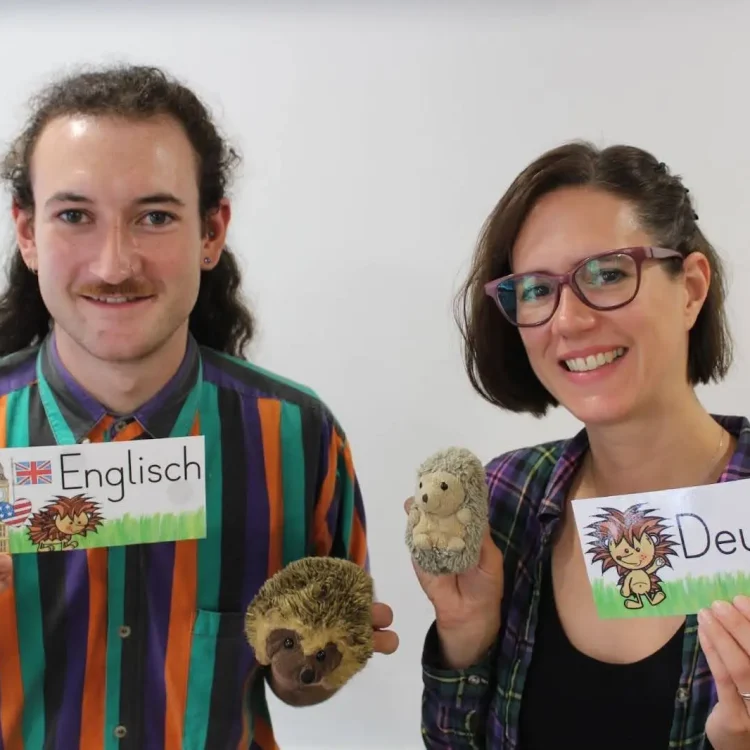
The Importance of IB Educators in Facilitating a Deeper Learning Experience
July 12th, 2023
Introduction
The International Baccalaureate (IB) program is globally recognized for its rigorous academic framework, designed to challenge students to think critically and engage deeply with their learning. At the heart of this framework are the IB educators, who play a pivotal role in creating a learning environment where students can thrive intellectually and personally. IB educators are not only trained to teach but are equipped with specialized skills that foster deeper learning experiences.
Rigorous IB Educator Training
One of the key aspects that set IB educators apart from their peers in traditional education systems is the rigorous training they undergo. IB teacher training is specialized, focusing on inquiry-based learning, interdisciplinary teaching, and global perspectives. This training is designed to equip educators with the skills to challenge students to think critically and engage with complex ideas.
IB teachers also participate in ongoing professional development programs, ensuring that they stay updated on the latest educational strategies and research.
How IB Teacher Training Differs from Traditional Models
Unlike traditional teacher training models, which often emphasize content delivery and subject-specific expertise, IB teacher training focuses on fostering inquiry, interdisciplinary learning, and a global perspective. Traditional models typically rely on direct instruction, where teachers are the main source of knowledge, and students are expected to absorb information passively.
In the IB system, educators guide students to discover and apply knowledge through critical thinking, hands-on projects, and real-world connections. This approach ensures that learning is not just about memorizing facts but about developing skills that students can apply throughout their lives.
Facilitating Deep Learning
IB educators prioritize student-centered learning, where the focus is on the student’s active participation in their learning journey. Rather than simply delivering content, teachers encourage students to ask questions, explore different perspectives, and engage in collaborative discussions. This shift from direct instruction to inquiry-based learning enables students to take ownership of their education, leading to deeper, more meaningful learning experiences.
Critical thinking and self-reflection are also central to the IB teaching philosophy. Teachers encourage students to question assumptions, evaluate evidence, and consider alternative viewpoints. This emphasis on inquiry, combined with opportunities for self-reflection, helps students develop the skills necessary to approach challenges with creativity and confidence.
IB Teacher Mindset
The mindset of IB educators is a defining factor in the success of the program. IB teachers are growth-oriented and constantly strive to improve their practice. They understand the importance of embracing a mindset of continuous learning, both for themselves and for their students. This dedication to growth is not limited to classroom techniques but also includes adopting new technologies and innovative strategies to engage students more effectively.
International-mindedness is another key component of the IB educator’s mindset. By embracing diversity and encouraging students to think beyond their local context, IB educators help students develop a deeper appreciation for different cultures and worldviews.
Commitment to Continuous Learning and Innovation in Education
IB educators are not static in their practice; they are always seeking ways to improve and innovate. Whether through adopting new teaching methods, integrating technology into the classroom, or exploring novel ways to assess student learning, IB teachers are committed to enhancing the educational experience. Their dedication to continuous improvement ensures that they are always prepared to meet the evolving needs of their students and to create learning environments that are engaging, challenging, and relevant.
Conclusion
IB educators play a crucial role in shaping students who are not only academically proficient but also independent, globally aware individuals. By fostering deep, inquiry-driven learning and prioritizing personal growth, IB teachers equip their students with the skills necessary to thrive in a complex, ever-changing world. Through their commitment to continuous learning and innovation, IB educators are shaping the next generation of critical thinkers, problem-solvers, and global citizens.
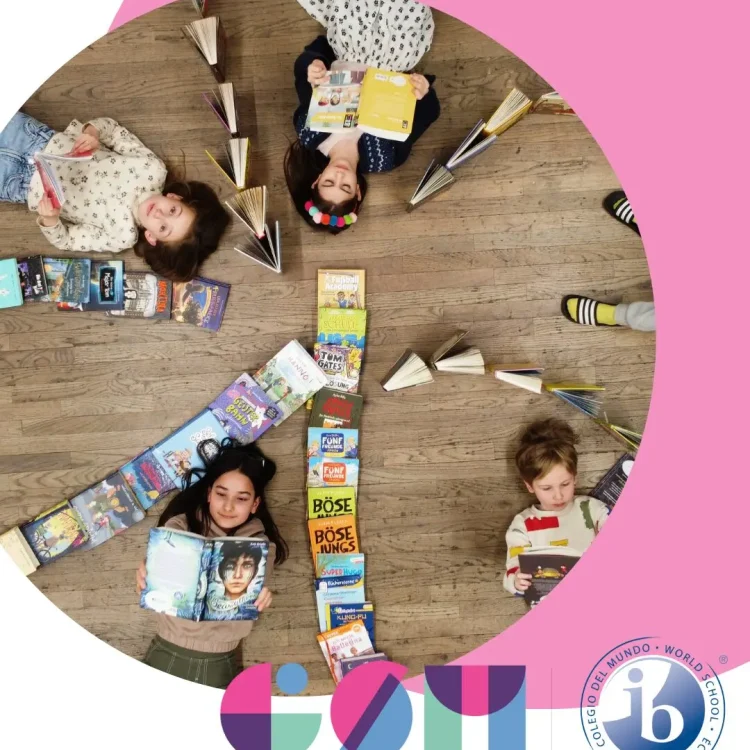
Community Outreach | A new school year has started
September 24th, 2025
Dear GSM Friends & Families,
Welcome back to a new school year! We love that fall is the season for meeting new families, and we’re excited to share the dates for our upcoming admissions events with you. Visiting GSM is a wonderful opportunity to experience our Program of Inquiry in action. We are so proud to share that GSM is an authorized IB PYP World School.
Our Preschool welcomes inquirers as young as 2 years old, and our K–5 program still has a few spots available. We are especially reaching out to families with children ages 2, 3, and 4 who may be ready to join our GSM community.
In New York City’s diverse educational landscape, German-American School Manhattan (GSM) stands out as an accessible option for families across all boroughs and New Jersey. With two campuses in Tribeca, our school – founded in 2018 – has become a top choice for families who value strong academics paired with dual-language immersion (English/German, with Spanish introduced in Grade 3).
GSM’s dedicated and multilingual educators deliver a stimulating Program of Inquiry that aligns with U.S. and German benchmark standards in all core subjects. Our transdisciplinary approach connects social studies, STEAM, and specialty subjects such as music, modern dance, and art – ensuring that learning is meaningful, creative, and engaging.
We would love to share more about our unique program with you and hope to see you at one of our upcoming events.
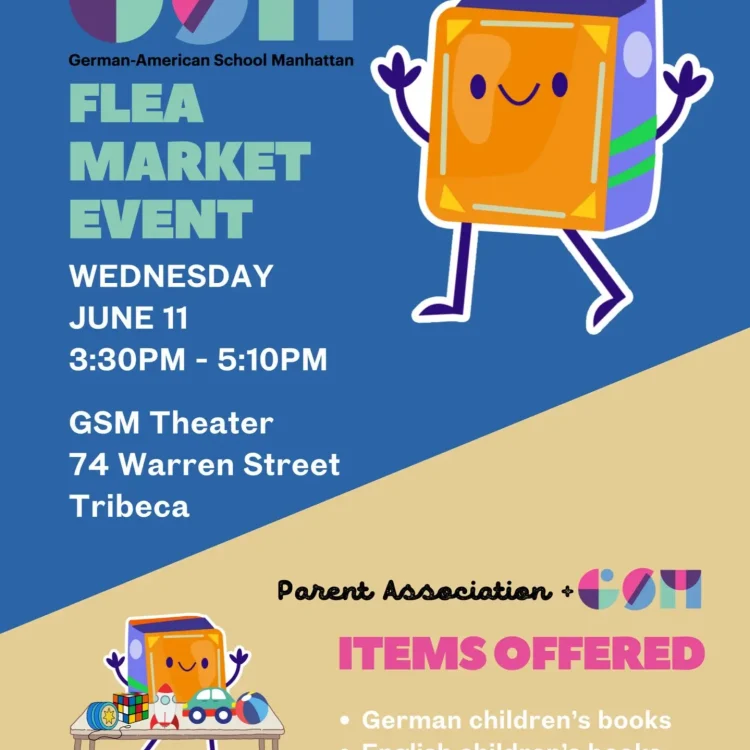
GSM Flea Market
June 11th, 2025
We’d like to invite your to our Flea Market event on June 11th at the theater at the Lower School at 74 Warren Street. The GSM families have collected books (German & English) as well as toys, board games and puzzles to find new owners. Coordinated by the GSM Parent Association this wonderful community event will bring us together and celebrate sustainability and entrepreneurship.
Read the whole newsletter here.
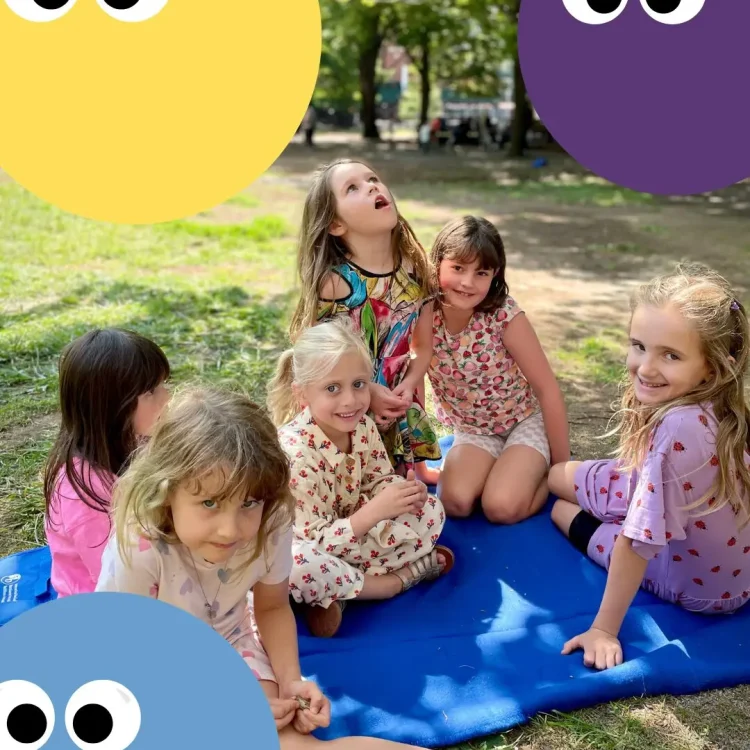
Happy summer break!
July 15th, 2025
We wish you all a happy summer break!
Here’s to slower mornings, spontaneous adventures, and soaking up every bit of the summer magic.
We look forward to seeing you on September, 2nd!
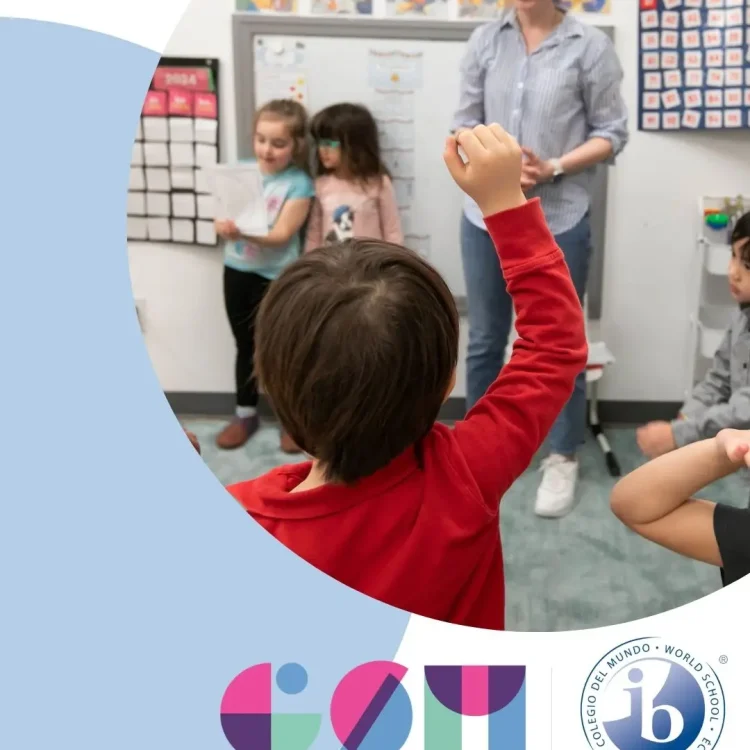
Open House & Community Playdate Season started!
September 3rd, 2025
GSM Open Houses & Playdates
In-person open house tours at 74 & 85 Warren Streets
Hurray! Fall & Winter Tour Season is on. We are excited to welcome prospective families to explore our campuses and see GSM in action.
Upcoming open house dates:
-
September: 9/18, 9/28
-
October: 10/3, 10/16, 10/20, 10/21
-
November: 11/4, 11/13, 11/17, 11/21
-
December: 12/4, 12/8, 12/9, 12/16, 12/18
Virtual Zoom Tours
Prefer a virtual visit? Please reach out to inquire about a Zoom appointment.
Community Playdates at 85 Warren St
We are thrilled that our open-format community playdate is returning this school year! The playdate is for children ages 1–6 accompanied by at least one parent. It’s a wonderful opportunity for interested families to:
-
Meet other GSM families
-
Let their kids experience our school first-hand
-
Chat with educators in a relaxed and casual setting
-
Get unique insights and answers to questions
Upcoming community playdates:
-
October: 10/9, 10/23
-
November: 11/6
-
December: 12/2
We can’t wait to welcome you to GSM and share our joyful learning community with you.
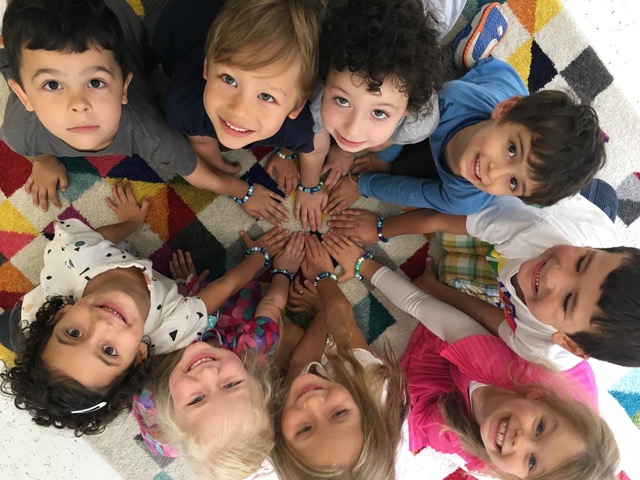
GSM Open Houses/Virtual Info Sessions
September 28th, 2021
GSM will grow into a full K-5 program and the new preschool is located just across the street!
For the 22/23 school year we are enrolling Preschool 3s & 4s, as well as grades 1-4 at our Lower School campus.
There are many dates to chose from, but feel free to contact us directly at info@devsite1.ggmtesting.com if you need an appointment at a different time.
New dates for in-person and virtual tours are available.
Please sign up with this LINK
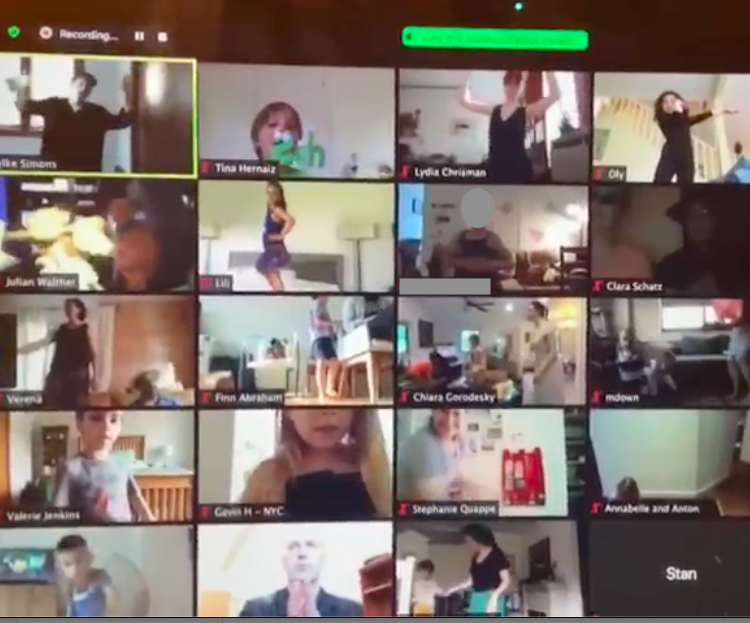
GSM concludes 2019/21 school year with remote learning & remote celebrations
July 2nd, 2020
Congratulations to all GSM students that completed the 2019/20 remotely. Highlights of the month of June were an Open Mic and a report card ceremony with Zoom dance party! Thank you to our teaches, who inserted so much love and dedication into the remote learning. This year asked so much of every single family – a well deserved party!
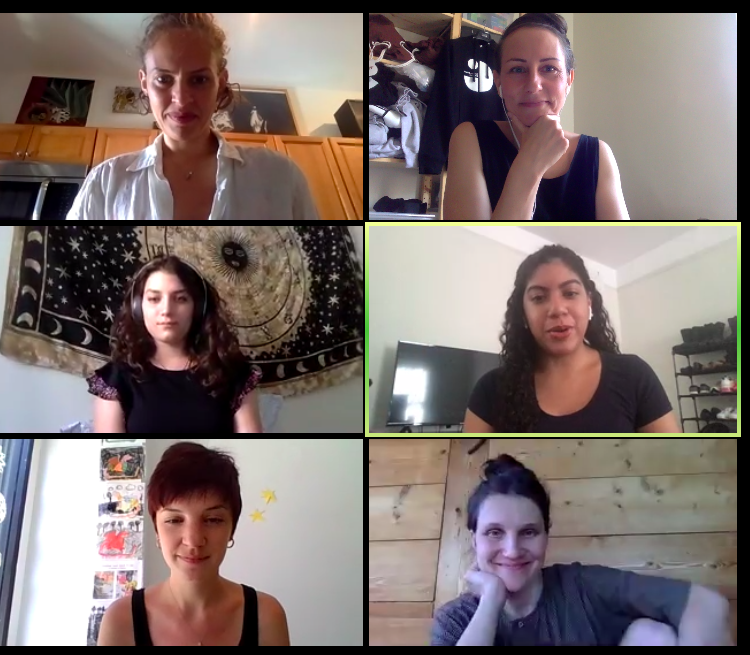
GSM Admin & Faculty preparing for a very special school year
August 26th, 2020
While the GSM faculty is preparing to come back to school on September 8th, the kids and families are full of anticipation of a school year that will be different in many ways. As the staff is getting location and materials ready, the excitement to be back in the classroom is growing by the minute. As we are carefully reviewing and implementing our reopening protocol, we simply can’t wait to see our students. Families will gather at a Zoom Townhall Meeting on Wednesday September 2nd that will address the reopening plan specifics and that will give everyone the opportunity to ask questions. What stays the same? Setting up classrooms, getting supplies ready, decorating. We are prepared to speak with our voices and bodies, to listen with our ears and eyes, and teach from our hearts.
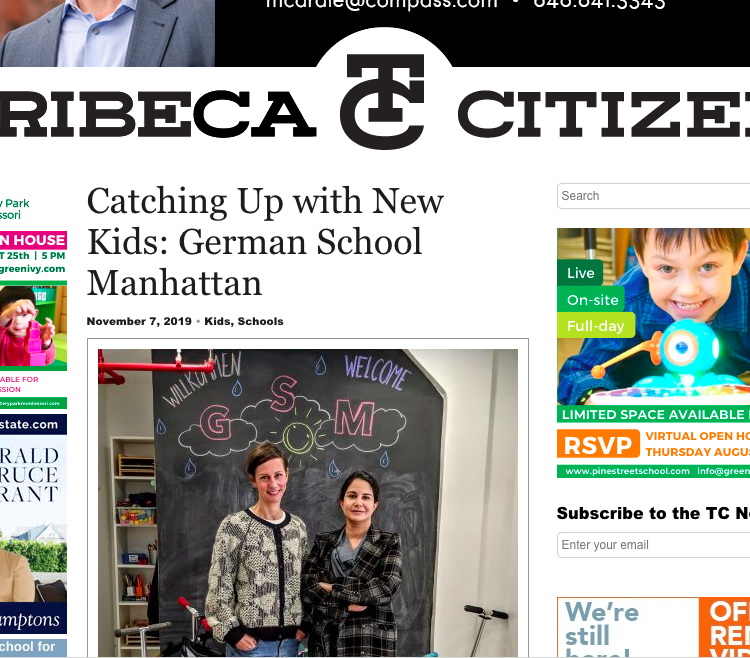
The Tribeca Citizen visits GSM
November 16th, 2019
Tribeca’s most local resident and journalist extraordinaire came to visit the “new kid on the block” GSM and wrote this wonderful piece for the Tribeca Citizen. Thanks, Pam!
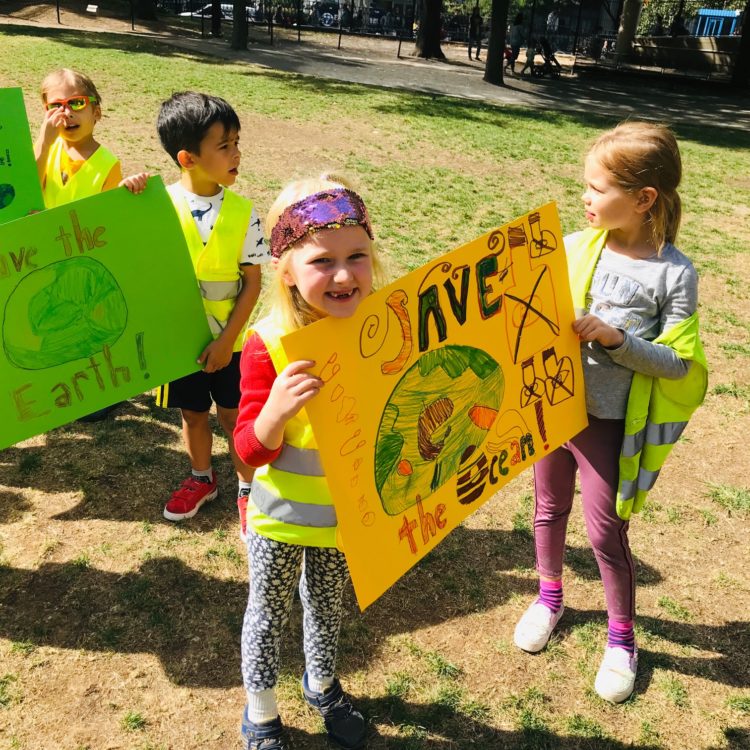
Climate Strike NYC
September 20th, 2019
GSM’s mission is to raise global citizens that stand up for justice and feel deeply connected to their environment. Our fine educators put together an entire weeks worth of education in honor of the Climate Strike. Our little protesters were headed out with their hand-made signs. Thank you to Melanie Adley for leading this effort and making it your mission to raise young activists.
Climate Awareness Week at GSM
Monday 9/16:
Readers Workshop – students learn about peaceful action and protests with book Peaceful Fights for Equal Rights
Tuesday 9/17:
Readers Workshop – students learn about different people who demanded change in America and consider what change they can make with book ENOUGH! 20 Protesters who Changed America.
Wednesday 9/18:
Social Studies (first block) – students watch book about climate change, Is this my Home?, and consider how the whole world is our home. Consider what they can do to keep our home / planet clean and safe (capture ideas of both K and 1 on an anchor chart to be used when making our signs on Thursday)
Thursday 9/19:
Writers Workshop – review the ideas we came up with and look at some examples of protest signs. In partnerships, GSM students will paint / write / decorate their protest signs.
Friday 9/20:
Music – Lydia teach a song / chant about the climate for GSM students
12:45 – All grades line up to march to park with their signs
#GSM
#GSMClimateStrike
#ClimateStrike
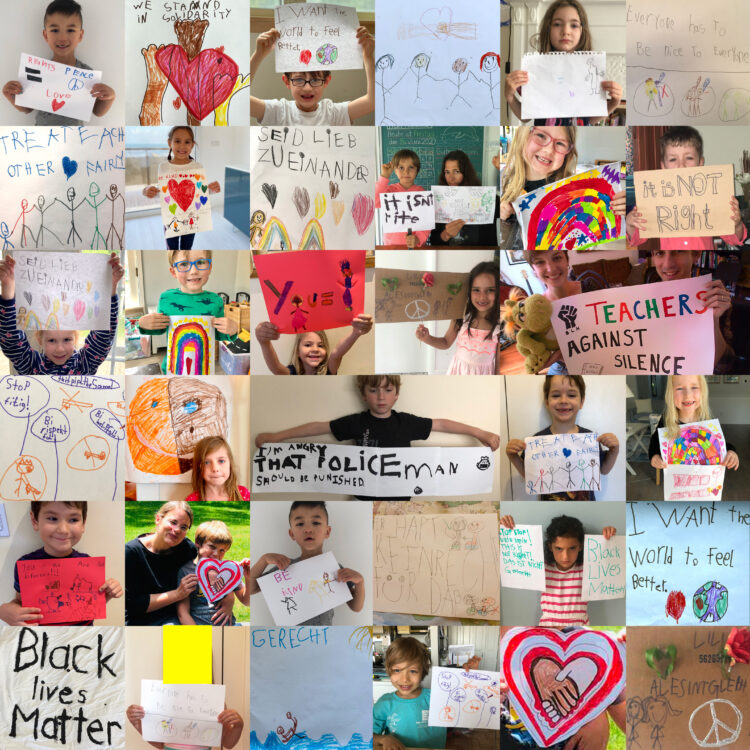
Anti Racism Remote Project
June 12th, 2020
Dear GSM Families,
We write this in shock and with sadness, as we mourn the lives of George Floyd in Minneapolis, Breonna Taylor in Kentucky, Tony McDade in Florida, Ahmaud Arbery in Georgia, amid countless others. We now see people all over the country rising up in defiance of these crimes, rising up in defiance of the systemic racism that affects every member of our society, rising up to have their voices heard.
Some teachers have already started talking about these events in age-appropriate ways with their classes, and we will continue throughout the week and beyond. As always we will keep the children’s developmental stage at the forefront, and we are working together as a staff to prepare how to best support the children and give them space to process what is happening all across our country as well as in our community.
This is an important opportunity, especially for white and non-Black people of color, to listen and learn, to stand with our black colleagues, friends, and family members, to learn how to be better allies and advocates. To the black families in our extended community, we stand in solidarity with you.
Here at GSM, we will prioritize growth opportunities for the staff during our weekly staff meetings, including revisiting our resources for how best to discuss hard topics like racism with children and adolescents. The English teacher Dr. Adley will take the lead on this, but all staff will be involved.
We will send out additional resources to support your conversations at home in due course. We’d also like to share an anti-racism resource primarily geared toward white people and parents to help support the fight against racial injustice in the United States. It’s about each individual working for collective change.
We are committed to constantly strive to do better in the work toward social justice. This is one step on a long road, but we have to keep walking.
In solidarity,
The GSM Team
GSM is open!
September 10th, 2020
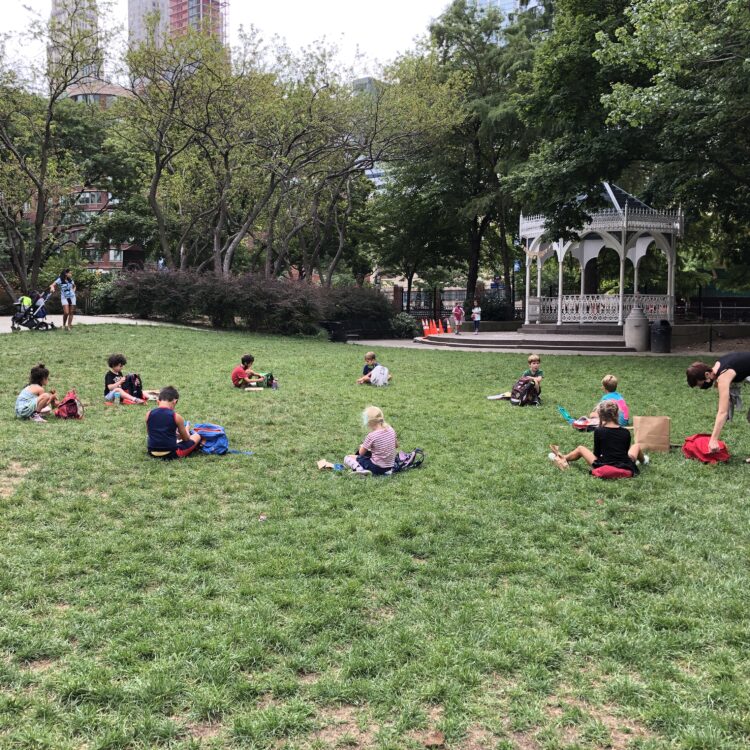
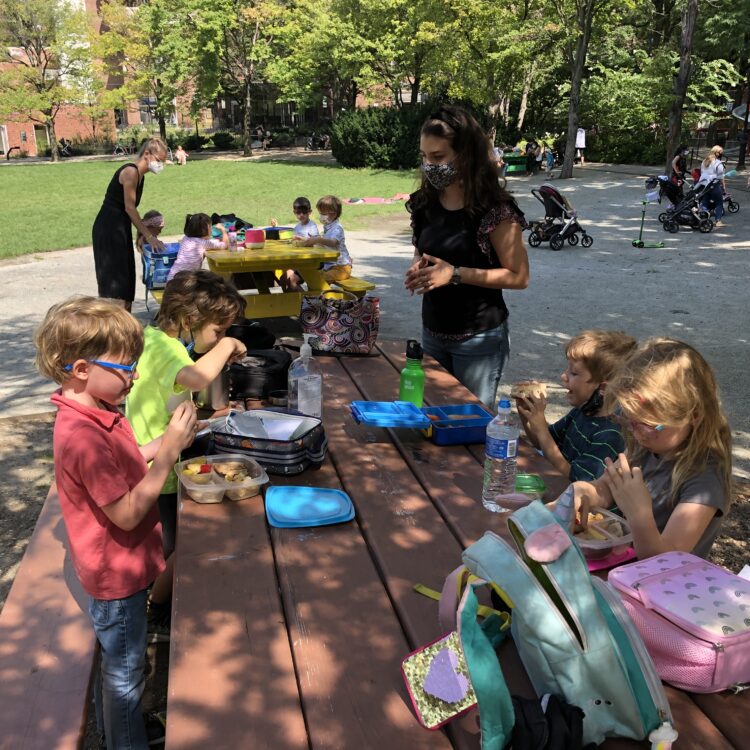
GSM is still a young school. Weighing out the pros and cons for a possible reopening kept us busy all summer. On September 8th, GSM reopened its doors to welcome back grades Kindergarten, as well as 1st and 2nd grade. The classrooms have a slightly different set up and mask wearing is a must for students and staff. GSM is lucky that its location offers enough space for all GSM students to be on site together (grades are no larger than 12 at the moment), so we didn’t have to opt for just a partial in-person model (hybrid). Some families are taking advantage of remote learning, the classrooms are streaming 3 live sessions a day. In some ways, being back in school is different. Hand hygiene, a strict protocol for material use and socializing in our rooms and in the park feels like we are learning it all over. But luckily some things are the same! Giggles, shares, ideas, lessons, stories, math – we are getting back into the groove. We want to thank the GSM community for supporting our reopening plan and making it happen. A very special thank you goes to our teachers that are tirelessly working on optimizing the learning experience. We will keep you posted, as we are settling into our new schedules and routines. Here are some pictures we took over the last few days.
Summer Camps are bookable now!
March 19th, 2021
We are so excited to be offering summer camp again! You can finally book them now. July is GSM Camps and August will be the return of the Galli Theater! Either way, you will find something good!
GSM Education Blog: Black History Heroes
March 26th, 2021
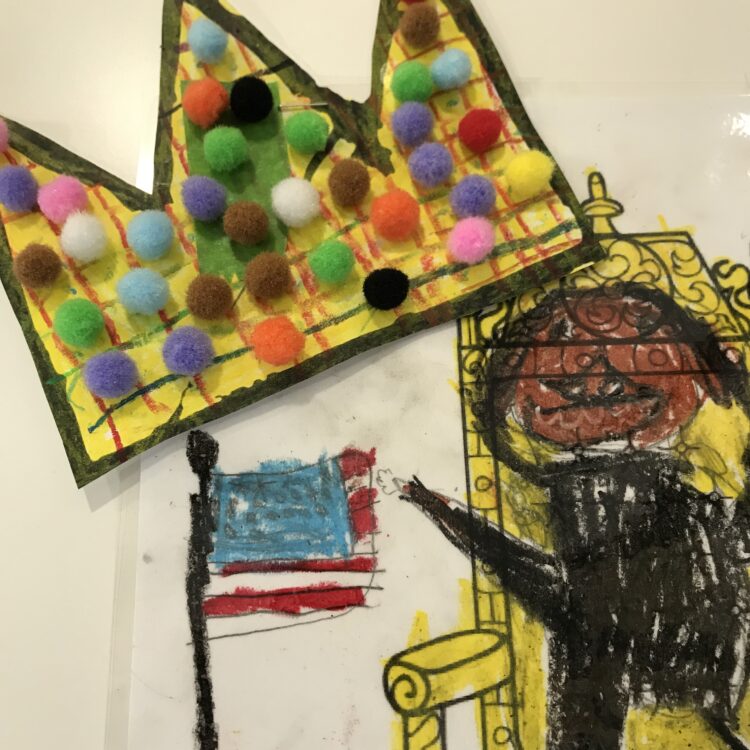
Black History Heroes : Portraits Inspired by Jean-Michel Basquiat’s Artistry
by Sydney Rivera, M.S. Ed.
In social studies, the Dolphin Classroom has been learning about historical figures in American Black History. We explored individuals from different professions and made sure to not only celebrate their contributions to society, but to also celebrate their uniqueness and qualities as a person. The students learned about Black artists, scientists, activists, athletes, writers, and leaders from both the past & present. They began to deeply admire these individual’s talents, as well as acknowledge the racial obstacles they had to overcome in order to achieve their goals.
For our end of unit project, students were assigned one Black History Hero and created a portrait of that person using the artistic influence of Jean-Michel Basquiat. Jean-Michel Basquiat was known for his vibrant portraits of ordinary people sitting on a throne, while wearing a crown over their heads to represent their importance and value. The students have shown a love for Baquiat’s royalty portraits and wanted to create their own interpretation of his artwork. After creating their portraits, they were each asked the question: “Why is this person a hero to you?”
Common themes included:
- Bravery
- Hard work
- Talent
- Doing the right thing even if it was hard
GSM Education Blog: FRESCH Thinking
September 14th, 2022
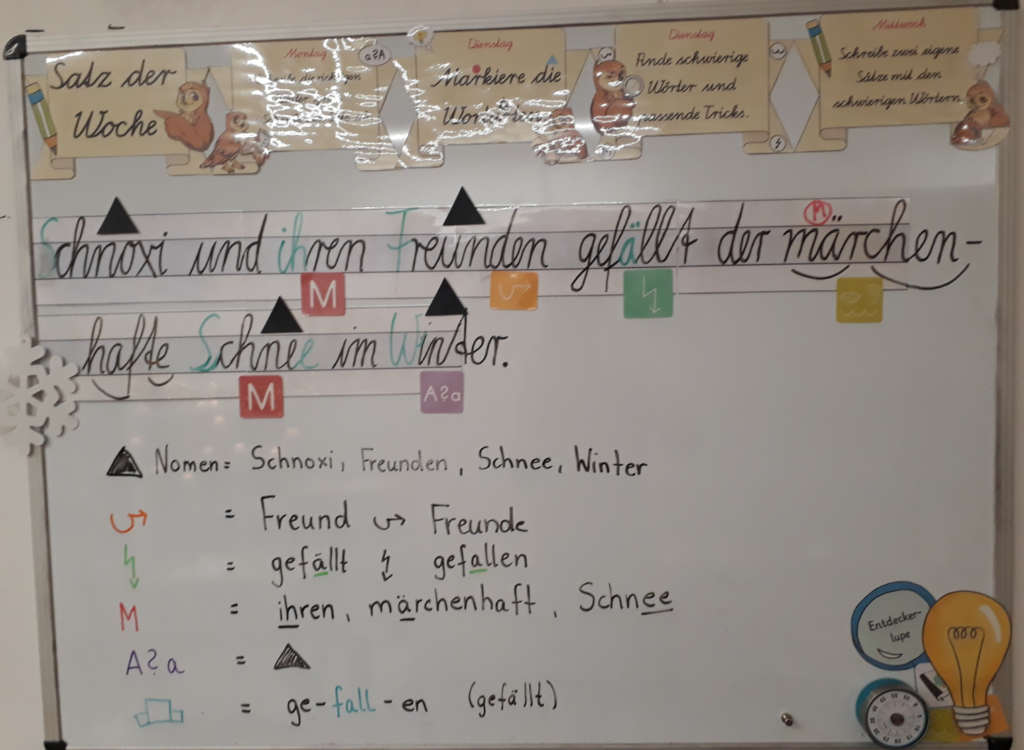
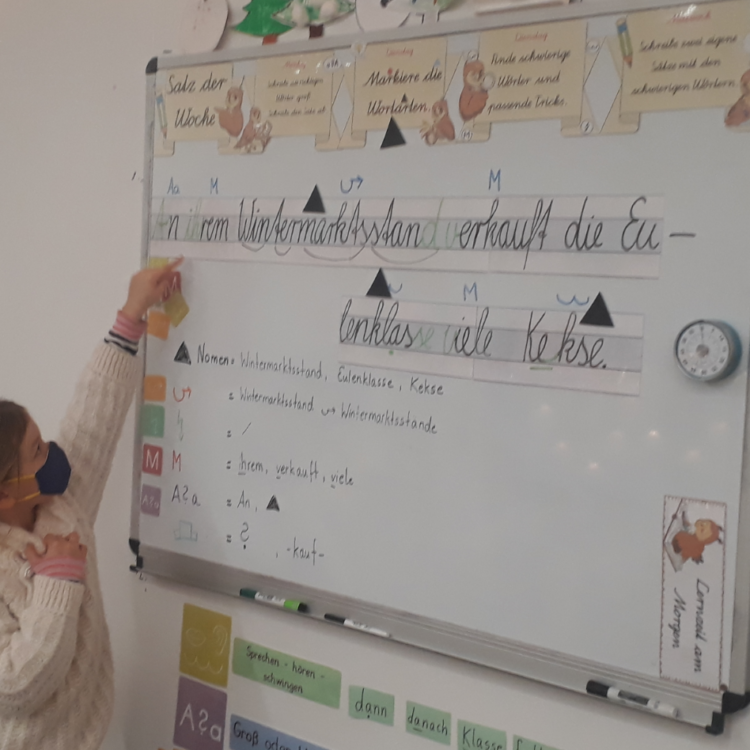
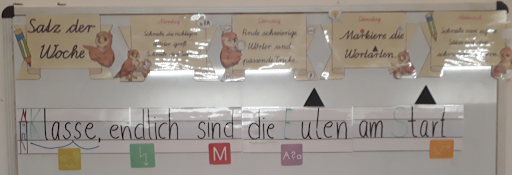
Above we have one example of what the FRESCH method looks like in practice in the second-grade. Every week we practice, discover, and deepen our knowledge of German orthographic rules with a new “Sentence of the Week.” We can see the FRESCH method here with the color-coded signs beneath specific words. These symbols recur while sentences change, helping the students to recognize regularities in German grammar.
While looking at the whiteboard above in the Owl classroom, you might also hear the sentence “gefällt is written with an ä and not with an e because it comes from the word gefallen!” (“gefällt schreibe ich mit a und nicht mit e, weil es von gefallen kommt!”).
The strategy above is called “Ableiten.” It means deriving the spelling of a word from another related word that explains why the vowel a becomes the umlaut ä.
This is but one out of six strategies that comprise FRESCH – a method that focuses on the regularities of the German language and that helps students to understand and logically deduce the spelling of a word. The FRESCH method is a fixed component of our German curriculum at German School Manhattan and it is a vital part of our German language lessons from Kindergarten onwards. The different strategies are taught alongside the regular German core curriculum and they enrich the grammatical components of the lessons.
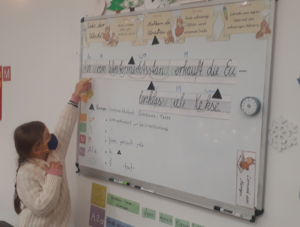
Beginning in the first grade, we work with a Sentence of the Week. In the example above, the first graders have already found the difficult parts of the words and explained them with the help of the FRESCH strategies. Each strategy is represented by a memorable symbol — this excludes the black triangles, which depict Montessori word classes.
The FRESCH method (Freiburger Rechtschreibschule) was developed by Günter J. Renk and Heike Buschmann as an approach to language that focuses on perception, movement, and rhythm. It was first developed for students with difficulties in reading and writing, but it soon became part of the regular curriculum in many elementary schools across Germany. School book publishers have adopted the method into their textbooks and extended it. At GSM, we can find this in our Zebra (Klett) textbook. Usage of this method has been validated in the elementary and secondary school levels.
The method comprises six strategies which are used to organize the school relevant vocabulary (we use the German core vocabulary for elementary schools as the basis) according to certain aspects words share in regard to spelling. These strategies can be understood as a tool kit that we offer our students to be prepared for independently deducing the spelling of words now, on an elementary level, and later on in secondary school since the strategies apply to the entire German language.
The syllable serves as the basis of orthographic writing and learning. It is understood both as the natural rhythm of a word and as a unit of segmentation to break down a word into shorter parts. Syllables are connected with movements so that the memorization and development of the natural rhythm is supported visually and aurally. This is called “rhythmisch synchrones Spreschwingen” and it is the first of the six strategies.
The strategies

Rhythmically emphasizing syllables
In the German lexicon, approximately 50% are spelled as they are pronounced. The rhythmic swing of syllables allows words to be broken down into shorter, simpler parts. When rhythmically emphasizing syllables, the individual sounds are exaggerated and every phoneme is to be identified. This strategy helps students write longer words independently. It is also connected with the rule that every syllable needs a vowel. This enables students to check their spelling independently after a little practice.
This basic strategy is taught and used in Kindergarten as it establishes the foundation for more advanced strategies. In Kindergarten, the students approach this strategy playfully by moving to syllables and discovering vowels as the core of syllables. In first grade, students continue using this strategy for more complex words. The focus is the identification of long and short vowels. The latter is crucial for second grade as orthographic rules are connected with long and short vowels in their regularities. This relates to double consonants, for example, or the use of the “sz” /ß/.
If a word cannot be spelled correctly with this method, i.e. if the word is not written as it is pronounced, then the other strategies come into play.

Extending words – Verlängern

For example, this strategy [Verlängern] is used when the end sound of the words cannot be clearly identified. These end sounds comprise the following sound pairs: b or p, d or t and g or k. The word is extended by one syllable to make the end sound audible.


This strategy is introduced in first grade and connected with German specific digraphs, as for example /ng/ vs. /nk/. This work continues in the following grades and is used as a means to explain and check the spelling of words.
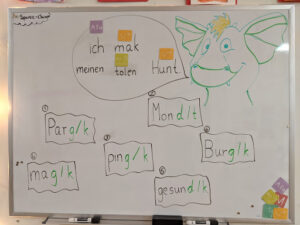

Our first-graders, the Dragons, have just learned about the strategy “Verlängern”. With the help of the symbols, they correct strategy-based mistakes in the Sentence of the Week.
Deriving the spelling

This is the strategy used in the example above. It is used when the spelling of a word with the similar sounding sounds of /e/ vs. /ä/ and /eu/ vs. /äu/ can only be derived from a related word with an /a/ or /au/ as the root vowel.

This strategy is introduced in first grade. It is used more frequently and with increasing complexity from second grade onwards.
Words that need to be remembered (Merkwörter)

All words whose spelling cannot be deduced from one of the strategies explained above are called Merkwörter. These words need to be remembered by heart.
In first grade, we focus on the most common of these words, in accordance with the German core vocabulary, e.g. und or sind.
In second grade, we focus on specific word families, e.g. all words beginning with V, words with ä without a related word, and more diverse words from the German core vocabulary.
In the bilingual context at GSM, we link German “Merkwörter” with English sight words. We use similar games and strategies to practice to offer the students different strength- and approach-based ways to remember the spelling of words.
Upper- or lower-case letters – additional strategies
Instead of a strategy, this symbol can better be understood as the summary of the regularities of upper- and lower-case letters in the German language (beginning of a sentence, nouns, names). We introduce these rules already in Kindergarten on a very basic level, although the symbol is only used from first grade onwards. We also use it as a means to compare regularities between our two languages.
Building blocks for words – additional strategies
Similar to the strategy above, “Wortbausteine” comprise a set of syllables. This symbol stands for common prefixes, suffixes, and word stems of the German language. The idea is that these components can be taken and put together to create a new word. An example is the word stem “-lieb-”. The part that needs to be recognized is the long vowel /ie/. If this syllable is remembered as a word stem, then it allows me to spell every word correctly that is part of its word family: Liebe, lieben, lieblich, verliebt, etc.
The most important word stems are introduced in first grade and are constantly reviewed in second grade.
When students are used to working with these strategies, it allows them to correct their own texts independently — the spelling of words no longer seems elusive, but can be explained with at least one of these strategies. In our German-English bi-lingual context, students suddenly start to compare discoveries they made in one of these languages with the regularities of the other. For students who learn German as a foreign language, the complexities of the German language become more accessible and more easily. understandable.
All strategy symbols: ©Ernst Klett Verlag GmbH, Stuttgart 2021. All rights reserved.
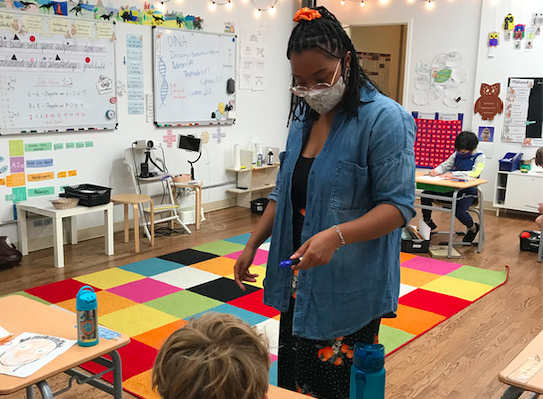
Educational Highlight: Getting “up close and personal” with DNA
April 30th, 2021
As part of GSM’s science/Sachkunde curriculum, we invited a very special guest teacher for a monthlong workshop called “Meine DNA und Ich” (4/7-4/28 2021)
Naiyiri-Blu Brooker, B.S Biology (Organismic Sciences):
As an intro to Science Week, the second grade Owls learned about the importance of DNA not only to us, but to all living things, such as plants, animals, insects and even bacteria.
Over the course of four weeks, they got up close and personal with our DNA structure. Like the term ‘Deoxyribonucleic Acid’ is extremely long, DNA is an extremely long ‘thread’ full of information, like our skin, hair, and eye color; our hair texture; our height; if we are left or right-handed; and most importantly, that all humans share about 99% of our DNA. They also learned that humans share 95% of our DNA with chimpanzees, 60% with a fruit fly and 50% with a banana, to show that DNA is the center of all life and that we are all connected because we have all at one point, far far in the past, shared a common ancestor.
Activity after activity, from drawing self-portraits to building our very own unique DNA structure, the second grade Owls soaked up all they could about the important ‘code’ that makes us Us.
They learned that every little detail about themselves, such as eye shape, ear shape, the way our paper cuts heal, the phenomenon of how we’re able to breathe, comes from a computer in our body that translates the building blocks that make up our DNA structure (A,T,C,G) into proteins that carry out the work and projects in our body. To help the Owls remember these important building blocks, the class came up with very funny phrases: “Gorillas trinken gerne Cola” (Gorillas like to drink Coke) and “Ananas/ Aepfel schmeckt am besten auf einer Torte” (Pineapple or Apples tastes the best in Pie). Both phrases were used to show the importance of the pairings of the building blocks in our DNA.
Through another fun activity the Owls learned about how sometimes our computers in our bodies make translation mistakes, how, in simple terms, misreading a building block (A) as (C) could accidentally give the person allergies against peanuts or pollen. How forgetting to translate a ‘code’, for example (ACG) becomes (AC), could give someone dimples or freckles. The owls learned that farmers do this all the time with our vegetables and fruits, for example expressing specific genes to get our modern-day bananas or strawberries. With a quick genome reading of four vegetables (Wild Cabbage, Kohlrabi, Cauliflower and Broccoli) the students were delighted to find out that Cauliflower and Broccoli are technically the same plant, just that farmers chose to express different genes to cultivate different looking plants.
As a final activity to ensure our students have become Future Scientists, they used the tools we all need as scientists: creativity, critical thinking, and a magnifying glass, to solve the stolen cookie case. They understood that even though our DNA tells us apart, it is inside our body and too small to see without special tools, but we still have another way to show how although we are all similar, we are also unique – our Fingerprints! Not one set of Fingerprints is like the other, even with twins. With this new information, and fingerprint clues spread around the classroom, the owls spent their final minutes of this science project finding the culprit of the stolen cookie case: Naiyiri-Blu Brooker.
With their Future Scientist Certificate and DNA knowledge, the second grade Owls are ready to be able to discover new things, create, think, and most importantly play. All the things that make each and every one of us a Scientist. From a Baker to a Painter.
Social City is coming to GSM
June 30th, 2021
Social City offers group social skills classes and individual speech-language therapy.
Curriculum information and consultation sign up here.
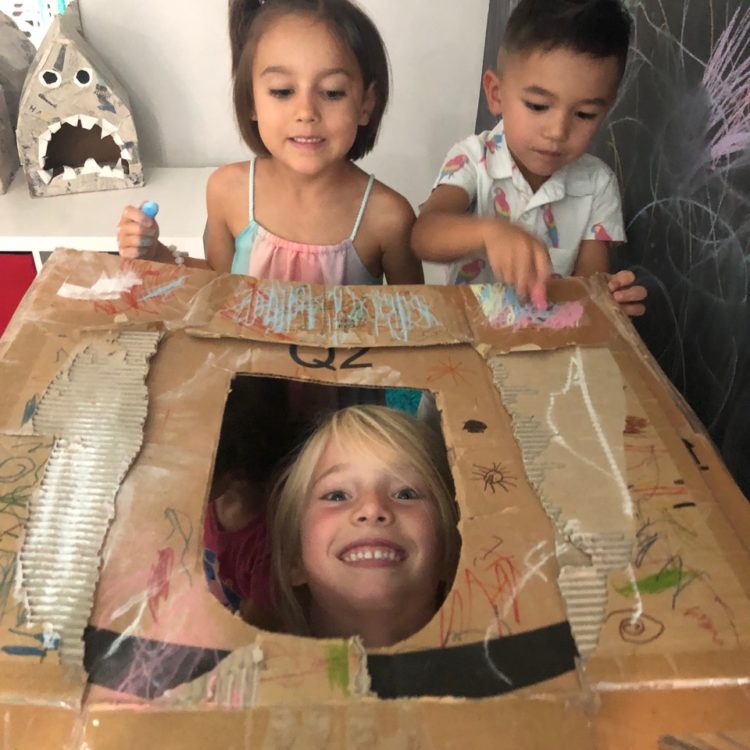
GSM has a pre-school! Virtual info sessions bookable now!
July 16th, 2021
Join us for an info sessions about the brand new Pre-K program
Thursday 12 & 19th at 10AM EST on ZOOM. Sign up here
___________________________________
We are starting our 4th year on September 9th 2021 by adding our first ever Pre-K class! The effort was inspired by our parents and we were happy to create this program that will start as a 4s only program and will extend into a 3s and 4s program the year after. The dual language immersion Pre-K curriculum will be the perfect preparation for GSM’s bilingual Kindergarten. The target language German will be favored in a 70/30 German/English language instruction ratio. The curriculum is project- and play-based and will provide the foundation for Kindergarten academics in both languages, science and math. We can’t wait to share more info with you. Please stand by for upcoming dates for virtual tours. You can take the tour if you’re interested in the current or next school year, or if you’re not sure yet if a bilingual setting is right for you. We will have the answers to your questions!
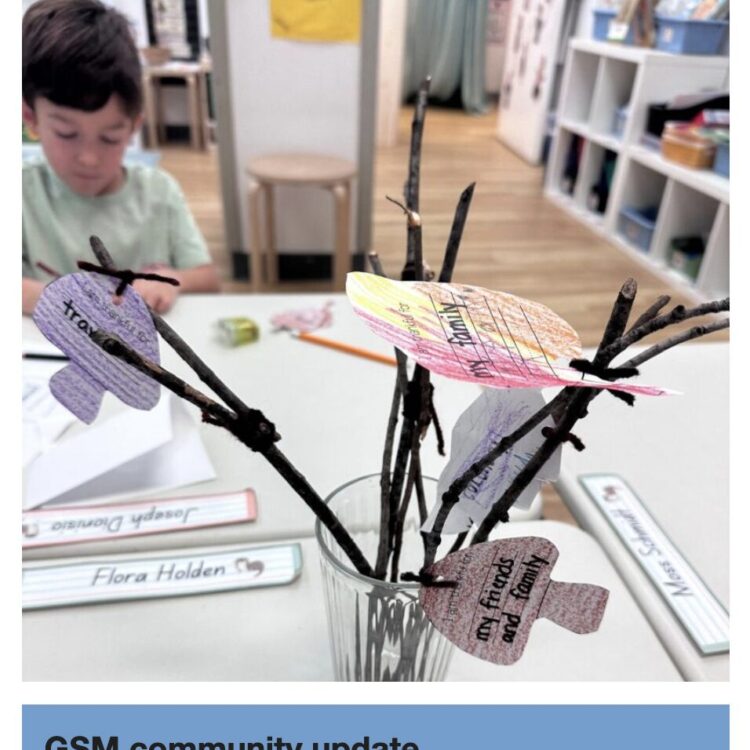
Baking for Relief in the Ukraine
March 17th, 2022
Dear Families, Friends, and Members of our GSM community,
As an international school and as an advocate for peace and global citizenship, the German School Manhattan would like to support the efforts to help Ukrainian children and youth that are directly affected by war.
We have identified the Mountain Seed Foundation as an organisation worth supporting. The Mountain Seed Foundation is a recognized NGO that helps children in international conflicts. Partnering with schools in Poland, the organisation is currently focusing on getting children and youth to safety and ensuring that they receive housing and care outside of Ukraine.
Fore more information, please visit the foundation’s website: https://mountainseedfoundation.org/.
To help fund their efforts, we would like to invite all members of our community to donate.
To that end, the GSM Parents’ Association has offered to collect the donations on their Venmo account.
The efforts to support Ukranian children in need are not limited to the grown-up members of our community however. In these past two weeks, the teachers have spoken with the students on different age-appropriate levels about the situation in Europe. As a result, it won’t come as a surprise that our students would like to actively get involved.
Therefore, we would like to invite you all to the GSM Bake Sale!
The students will write and draw posters, and sell cookies, cakes, and other treats in front of the park together with their teachers.
When: Thursday, March 17 from 12:45pm onwards Where: in front of Washington Market Park
PA Venmo Account: @GSM-parents
The store will be set up by teachers and students but you are very welcome to join us as customers!
All proceeds will be donated to the Mountain Seed Foundation to help Ukrainian children in need together with the donations on the PA’s Venmo Account.
Thank you for being part of wonderful GSM community!
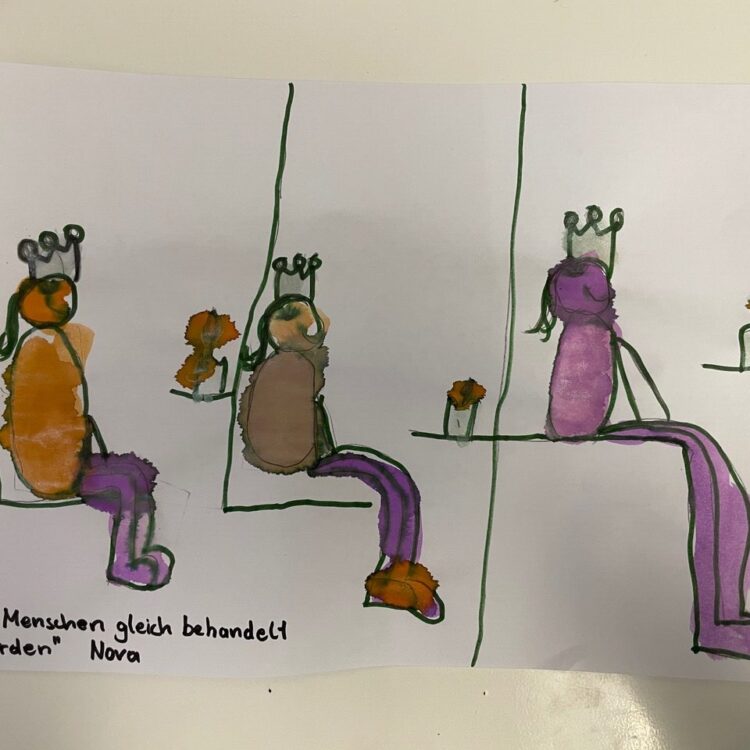
Teaching Highlight: “Malala’s magischer Stift”
May 1st, 2022
GSM’s buzzing community calendar
September 17th, 2022
Dear GSM Community,
GSM has just completed the second week of the new school year & we would like to share with you the ongoings and offerings around our school. We really have not stood still for a second this summer:
As most of you know, our 74 Warren Street location has been renovated & as some of the common areas are still being completed, the new *and absolutely stunning* performance space is already operational.
Dance and music classes took place there for the first time yesterday and our friends from the Galli Theater have been rehearsing their newest show, that will open today at 2PM (another performance tomorrow at the same time). Your whole family will love “The three little pigs” (in English). A young cast of skilled actors will engage and delight their audience by asking for support with funny dilemmas, as well as more existential problems. Galli always delivers, managing to walk the line between fun & thoughtful. If you have not had the pleasure of seeing this talented company perform, don’t miss this opportunity to join and support their incredibly ambitious mission.
GSM is offering an extremely divers after school program this year. We started this Monday and couldn’t have hoped for a better outcome. Kids can chose activities exactly to their liking and needs. The best news is: we still have some spots open for this semster! The choices range from German language classes, music, chess (E), architecture (E), hiphop, soccer (E) & of course theater!
We are excited that the German speaking community has other weekend events coming up in looming October, which you should bookmark now: The infamous GSB BLOCKTOBERFEST in Fort Greene is taking place only a week away from the GAPP BLOCKPARTY (more info below).
We want to thank our GSM community for being so welcoming to our new families. The PA’s back to school picnic was the highlight at the end of a successful week. Thanks to all the GSM parents that pitched in, showed up & that make us who we are!
Most importantly: the return of the IN-PERSON OPEN HOUSE IS HERE! Please sign up and share our upcoming admission events for GSM Kita Preschool & GSM Dual Immersion K-5! (First tour is this Wednesday 9/21)!
It is my absolute pleasure to continue to share with you what we have in stock for 22/23.
Warmly & with gratitude,
Julia Stratmann
GSM Community Event: Tag der offenen Tür mit Galli & Kinderbooks!
November 19th, 2022
In case you missed it: German School Manhattan (GSM) is now a full K-5 program and recently added a Preschool. The two beautiful locations are right across from each other and the home of two further big names in NYC children’s programming: Galli Children’s Theater (you can see them perform on the brand-new stage) and the Kinderbooks library that holds many book treasures for young readers!
On Saturday November 19th all doors will be open so you can tour both locations, chat with the GSM educators, experience an interactive play & participate in German-language story time. It will be an amazing opportunity to explore the unique offerings for families that speak or strive to speak German at home. All families are welcome.
GSM, Galli & Kinderbooks have curated the academic experience for GSM students and after school students into an inspiring and artistic learning experience.
We can’t wait to show & tell you more about our programs on November 19.
Saturday, November 19th 11AM-12:30PM
74 Warren Street & 85 Warren Street
RSVP here:
https://forms.gle/pZQpHdapKdYWoetZ7
About GSM:
German School Manhattan is an international independent Pre-School, Kindergarten & Elementary School. GSM is the first bilingual English-German school in Manhattan. The Tribeca campus is well situated, surrounded by parks and playgrounds and easily accessible
Small classes allow for dedicated student-teacher interaction. Expertly trained educators teach in their native language. GSM’s program is stimulating for curious learners and promotes a culture of empathy and understanding. Music, dance, theater, and STEM are an integral part of the blended curriculum that adheres to internationally benchmarked standards.
Knowledge of German is not a prerequisite to apply.
Find out why GSM’s bilingual curriculum will be a game changer in your kids’ educational journey!
germanschoolmanhattan.org/apply
About Kinderbooks:
Looking for quality German children’s books? KinderBooks has a curated selection of the best titles among modern classics and new releases for kids aged 0-12 years. Sign up for our rental subscription and receive age appropriate books for your kid every month.
Kinderbooks.nyc
About Galli Theater:
Galli Theater NY – Most progressive interactive fairytale theater in NYC for the whole family!
Housed inside the beautiful GSM, we offer theater workshops during all major school holidays and classes during the week, along with birthday parties, 2pm shows on weekends for the whole family, as well as workshops and evening performances for adults!
https://gallitheaternyc.com
GSM Tag der Offenen Tür Schedule:
11 AM Meet the directors: Beatrice, Barbara & Julia
74 Warren Street
11:30 AM Interactive Play for Kids ages 5-12 (with Barbara)
Parents Tour the Elementary School 74 Warren Street
12:00 PM Story Time for Kids ages 2-4 (with Beatrice)
Followed by “playdate” at 85 Warren Street GSM Preschool
12:30 PM End
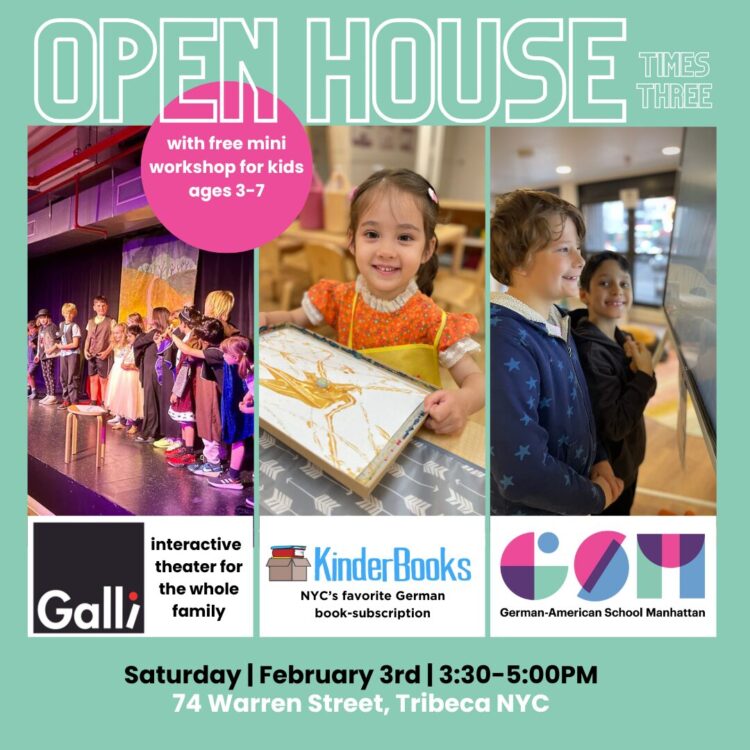
Back by popular demand: Tag der offenen Tür – Mit Galli & Kinderbooks!
February 3rd, 2024
Wir machen die Türen auf:
Visit GSM, Galli Theater & Kinderbooks
Join us on Saturday, February 3rd and experience what the GSM campus in Tribeca has to offer.
All doors will be open so you can tour both locations, chat with the GSM educators, experience an interactive play & participate in German-language story time. It will be an amazing opportunity to explore the unique offerings for families that speak or strive to speak German at home. All families are welcome.
GSM, Galli & Kinderbooks have curated the academic experience for GSM students and after school students into an inspiring and artistic learning experience.
We can’t wait to show & tell you more about our programs!
Saturday, 2/3 3:30PM-5:00PM
74 Warren Street & 85 Warren Street
Kindly,
Julia Stratmann, Barbara Remus & Beatrice Beckmann
SIGN UP HERE
—–
GSM Tag der Offenen Tür Schedule:
3:30 PM Meet the directors: Beatrice, Barbara & Julia
74 Warren Street
4:00 PM Interactive Play for Kids ages 5-7 (with Barbara)
Parents Tour the Elementary School 74 Warren Street
4:30 PM Story Time for Kids ages 2-4 (with Beatrice)
Followed by “playdate” at 85 Warren Street GSM Preschool
5:00 PM End
——
In case you missed it: German School Manhattan (GSM) is now a full K-5 program and recently added a Preschool. The two beautiful locations are right across from each other and the home of two further big names in NYC children’s programming: Galli Children’s Theater (you can see them perform on the brand-new stage) and the Kinderbooks library that holds many book treasures for young readers!
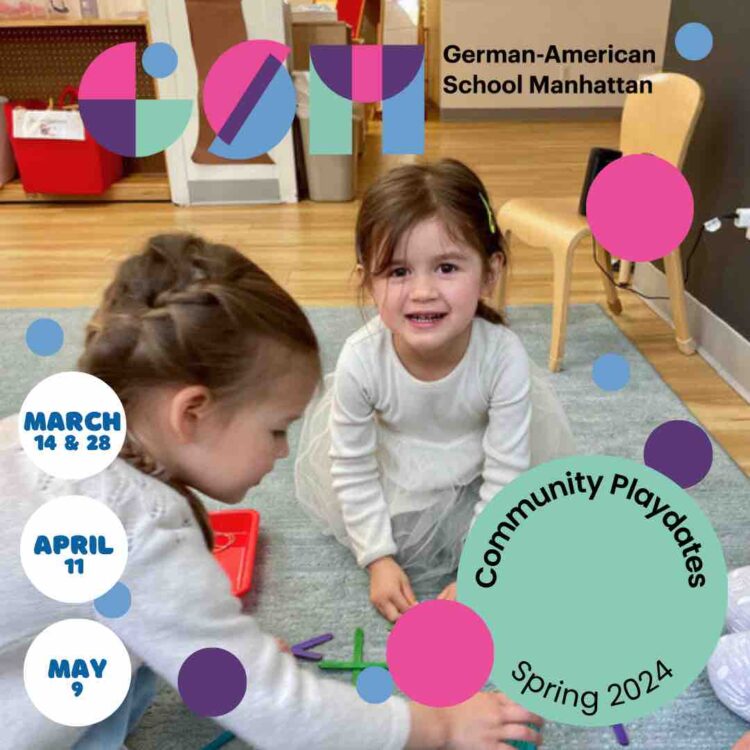
Sign up for the Spring Community Playdates!
March 14th, 2024
The playdates have been created so you can experience the GSM Preschool while the kiddos are in action. If you aren’t decided yet for next school year and you are considering to apply for Kindergarten, PreK or our 3s program (a limited amount of spots are available), just join us at our next playdate in! Sign up is a breeze and we will have fun activities ready.
We have four dates for this Spring to choose from: March 14 & 28, April 11th, May 9th.
Auction Night is on May 17th
May 17th, 2024
It’s happening on 5/17 and it’s gonna be FUN! GSM Parent Yuval is playing with his Band The Big Lazy and Ning (our fearless auction night coordinator) has already rolled out an impressive menu & auction! You can still get tickets here! Don’t forget to book your babysitter! Extended program with dance party running until midnight. Want to get involved? Write to donategsmauction@gmail.com – DANKE!
Join Admissions Events before the Summer Break
June 5th, 2024
Before the school year ends, we have a couple of more opportunities to experience GSM.
In-person open house tours at 74 & 85 Warren Streets
Wednesday June 5th at 9:15AM – 10:05AM
Virtual Zoom tours
Wednesday June 12th at 10AM -10:30AM
The open format community playdate is returning this Spring! The playdate is for Kids ages 1-6 accompanied by at least one parent.
The play date is a wonderful opportunity for interested families to meet other GSM families and have their kids experience our school first hand. Parents can chat with educators in a casual setting and get unique answers and insights.
Thursday, May 9th at 4PM – 4:45PM
Thursday, June 13th at 4PM – 4:45PM
Tour our two locations now
September 25th, 2024
The first two events are approaching fast, more dates at www.germanschoolmanhattan.org/apply.
GSM Preschool Window gets a makeover
September 11th, 2024
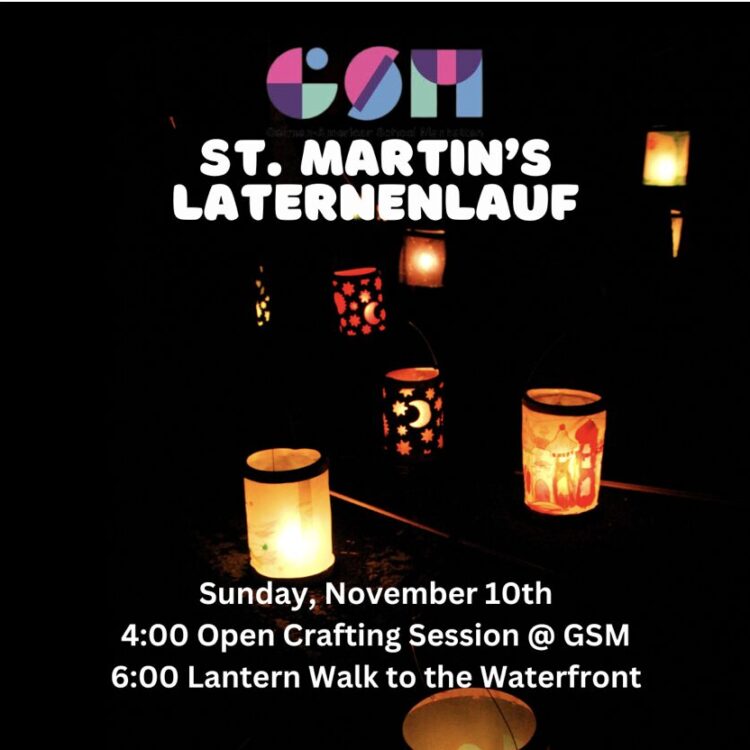
GSM Parent Association hosts St. Martin’s Lantern Walk
November 10th, 2024
For those not familiar with this tradition, the origins include the story of Martin of Tours, a Roman soldier who shared his cloak with a cold beggar on a winter’s night. This story offers an opportunity to talk about kindness and generosity with children, and is also a time for our community to gather, sing, and spend time together. For questions, please contact gsm-pa@googlegroups.com.
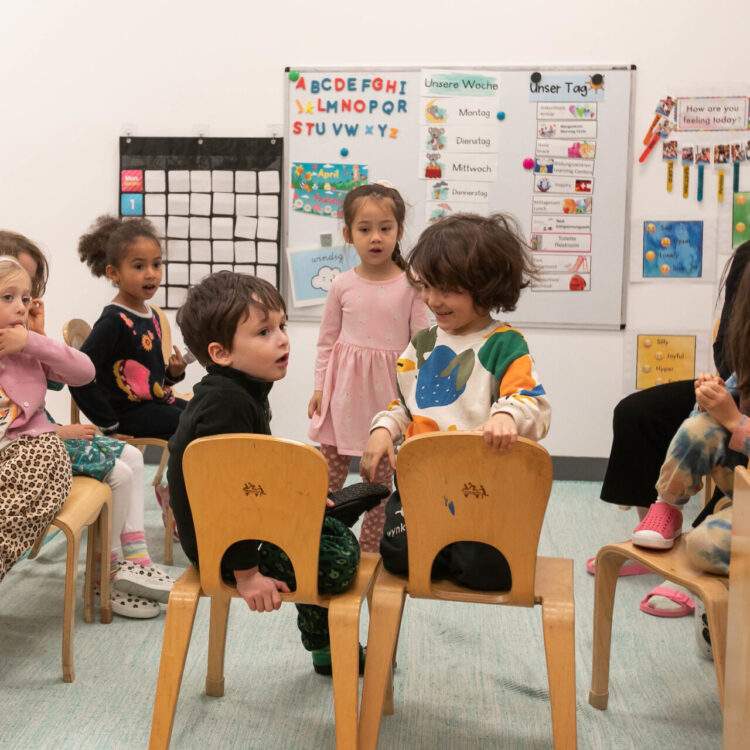
The Benefits of Bilingual Preschool Education
November 19th, 2024
German-American School Manhattan is enrolling for the bilingual preschool program! Dual language immersion can provide lifelong advantages especially if started in the early childhood years. Here you can learn more about GSM’s program, the benefits of the curriculum and our admission procedure.
Getting an early start with GSM’s bilingual preschool
In an increasingly globalized world, the ability to communicate in multiple languages is a key advantage. At the German-American School Manhattan, we understand the profound impact that bilingual education has on a child’s cognitive and social development. Our bilingual preschool program is designed to immerse young learners in a supportive environment where they can acquire both German and English language skills from a very early age.
Our inquiry-based preschool curriculum is designed for 3 and 4 year-olds, and optimally prepares young learners for bilingual kindergarten and the elementary years (K-5). It consists of a 70/30 German to English language instruction ratio. The preschool program is inquiry and play-based discovery in a bilingual setting sets the foundation for many cognitive skills and supports mathematical skills and scientific thinking.
Cognitive Advantages of Bilingual Learning
Numerous studies have shown that preschool bilingual education has a positive impact on a child’s cognitive abilities. By exposing children to at least two languages at an early age, their brains become more flexible and adaptable. This cognitive flexibility translates into enhanced problem-solving skills, improved memory, stronger focus, and longer attention span. Additionally, bilingual preschool education leads to enhanced communication skills by expanding vocabulary in both languages and sharpening listening skills.
Research also indicates that the preschool years are the optimal time for second language acquisition, as children can more easily achieve native-like proficiency during this critical stage of brain development.
Bilingual Learning Opens Up the World
Learning a second language is not just about acquiring linguistic skills; it also opens doors to a rich cultural diversity. At our bilingual preschool, children are exposed to German culture, traditions, and customs, fostering a deeper appreciation for diversity and global perspectives.
Additionally, being proficient in multiple languages can lead to exciting career opportunities, as it enhances communication and collaboration in an increasingly interconnected world. This skill makes individuals more competitive in a variety of fields such as international business, translation, education, diplomacy, and more.
SEL Benefits of Bilingual Learning
Bilingual preschool education has valuable social-emotional benefits, as it is shown to boost children’s self-confidence and social skills. Navigating between two languages helps children develop a strong sense of identity and become more confident in diverse social settings. Early exposure to language immersion equips them with the tools to communicate effectively and build meaningful connections with people from various cultural backgrounds.
GSM Preschool Admission
We understand that choosing the right bilingual preschool is a significant decision for parents. At the German-American School Manhattan, our admission process is designed to ensure a seamless transition for both children and families. GSM is offering admissions events and tours year-round.
To learn more about our bilingual preschool program and admission requirements, please visit https://devsite1.ggmtesting.com/apply/. To start the admission process please email us at info@devsite1.ggmtesting.com.
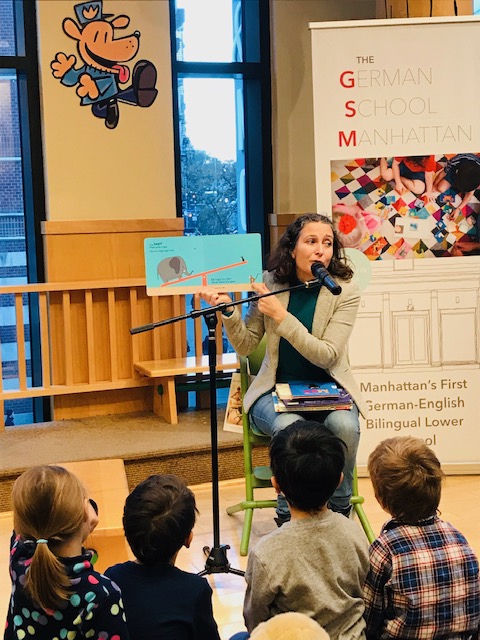
GSM Story Time with Kinderbooks at Barnes&Noble
November 13th, 2019
GSM is a proud partner of KinderbooksNYC. Owner Beatrice Beckmann keeps her extensive library of carefully curated German language books on our premises at 74 Warren Street. She’s also a mother of two (one a current and one a future GSM student). Please find out more about the subscription-based book service at www.kinderbooks.nyc. Is as easy as receiving mail!